Parlez-vous français ? Whatever Happened to the ‘Language of Diplomacy’

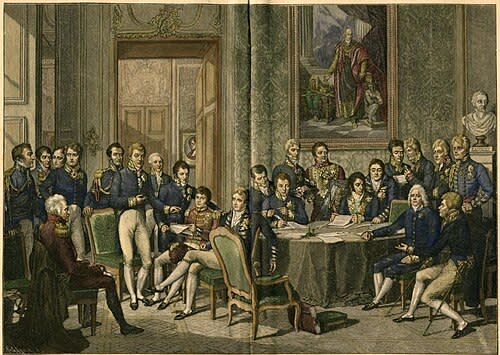
The Congress of Vienna (1815), drawing by Jean-Baptiste Isabey, engraving by Jean Godefroy. (Wikipedia)
In 2024, the Francophonie Summit was held in Villers-Cotterêts, France, a place rich in symbolism recalling the famous ordinance of the same name issued in 1539 by François I, which established French as the official language of the State and replaced Latin. Today, French stands as the world’s fifth most-spoken language according to the OIF, and its use has become a major political and diplomatic stake, particularly for France
From the Language of Diplomacy to the Rise of English
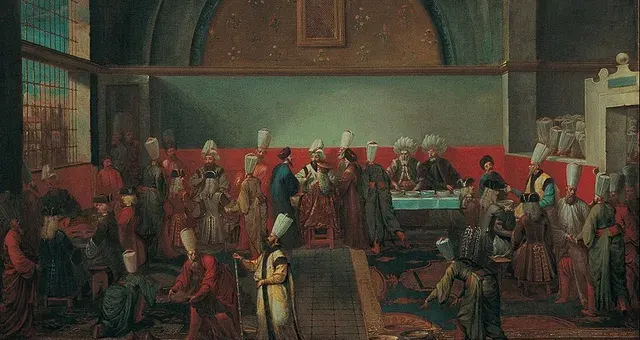
French emerged as the dominant diplomatic language in Europe during the seventeenth and eighteenth centuries. The first treaty written entirely in French was the Treaty of Rastatt (1714), which ended the War of the Spanish Succession. During the Congress of Vienna in 1815, despite France’s defeat after the Napoleonic Wars, negotiations were conducted in French under the guidance of Metternich, who justified this choice by the need for a common diplomatic language. By the nineteenth century, French had become the working language of Ottoman diplomats and was widely regarded as the language of commerce, the arts, and the sciences.
Despite this dominance, the twentieth century witnessed the gradual rise of English at the expense of French. The decline of French as a diplomatic language began to be discussed around 1910. During the Paris Peace Conference of 1919, English was adopted as a working language alongside French, and the Treaty of Versailles was written in both. After the Second World War, as France’s geopolitical influence waned, the use of French in diplomacy steadily declined.
Today, France maintains its linguistic influence largely through its position within the United Nations, where only French and English are recognized as working languages within the Secretariat and as official languages alongside five others: English, Spanish, Russian, Chinese, and Arabic.
Speaking French in international institutions - a strategic challenge.
One might therefore believe that within international institutions, French is not truly in decline, as reflected by its high status at the UN and within European institutions. However, as early as 2014, a report by the French National Assembly noted a clear decline in the use of French within the European Union, with the notable exception of the Court of Justice of the European Union, whose working language is French. The same report pointed out that, even before Brexit, appointments to European bodies often favored native English speakers, a situation that has not significantly changed since, particularly within the European External Action Service. This report also pointed out, even before Brexit, that appointments to positions within European bodies often favored native English speakers ; a situation that has not really changed, even after Brexit, particularly within the EEAS.
The influence of the Francophonie is a highly strategic objective for France. Through the OIF, France reinforces the use of its language, especially in Africa, the Middle East, and across its former colonies. The OIF is not merely a tool for linguistic development. It explicitly seeks to promote shared values such as peace, democracy, and human rights, while also serving as a platform for multilateral negotiation among French-speaking countries.
The Francophonie: Cultural Project or Political Instrument
This vision nevertheless raises criticism. The Francophonie often carries the weight of post-colonial interpretation, perceived by some as a remnant of French cultural dominance or as a “butin de guerre”, through which France attempts to maintain a declared political influence in formerly colonised and therefore Francophone regions..
The challenge for France and the French language today is not merely to increase the number of French speakers worldwide. The real issue lies elsewhere. The number of francophones has indeed grown, from around 200 million in 1965 to over 321 million today according to the 2022 OIF report, but this increase is largely demographic, driven by population growth in sub-Saharan Africa rather than by renewed global influence. Within international institutions and diplomacy, French retains a significant, yet often symbolic presence. It is frequently listed alongside English, but in practice English dominates daily communication and documentation. While French was historically the language of diplomacy, its position today is increasingly fragile.
The Paradox of Influence
France has made the promotion of the Francophonie a political priority, yet several countries are now moving in the opposite direction, seeking to distance themselves from the French linguistic sphere. Algeria’s recent decision to promote English rather than French in its schools and universities illustrates this shift. As Pierre Bourdieu noted, language is a form of symbolic power, and the decline of French in diplomacy mirrors the shifting hierarchies of global influence.
The survival of French as a diplomatic language no longer depends solely on its historical prestige or the number of its speakers. Its future will depend on whether it can embody a renewed vision of cultural plurality ; one that reconciles its heritage with a modern, inclusive, and post-colonial understanding of international communication
Sources.
Kalinowska, E. (2011) ‘Francophonie, concept postcolonial?’, Romanica Silesiana.
Chaubet, F., Faucher, C., Martin, L. & Peyre, N. (2024) Histoire(s) de la diplomatie culturelle française : Du rayonnement à l’influence, Toulouse : Éditions de l’Attribut.
Martin, L. (2024) ‘L’autre diplomatie culturelle : le rôle international du ministère de la Culture de 1959 à 1993’, in Chaubet, F., Faucher, C., Martin, L. & Peyre, N. (eds.) Histoire(s) de la diplomatie culturelle française : Du rayonnement à l’influence, Toulouse : Éditions de l’Attribut, pp. 83-103.
Chaubet, F. (2004) ‘L’Alliance française ou la diplomatie de la langue (1883-1914)’, Revue Historique, 632(4), pp. 763–785.
Anonyme (n.d.) Francophonie et mondialisation, Université Lyon III.
Organisation internationale de la Francophonie (n.d.) Face aux enjeux mondiaux.
Le Devoir (n.d.) ‘Le français, langue de la diplomatie’.
US Journals (n.d.) Kalinowska, E. ‘Francophonie, concept postcolonial?’, Romanica Silesiana.