Beyond the Menu: The Soft Power of Mediterranean Commensality

In 2013, the “Mediterranean diet” was added to the Representative List of the Intangible Cultural Heritage of Humanity, a recognition that goes beyond nutrition to highlight a set of knowledge, practices, and rituals centered on sharing meals, hospitality, and cultural diversity. We will see that this culture of eating together, or commensality, is more than just a way of life; it is a symbolic resource that can be mobilized in diplomacy, serving both to build a national image and to influence and shape inter-state or inter-community relations. In this article,I examine how these practices in Mediterranean countries have been transformed into instruments of soft power, from the historic state banquets of the Ottoman Empire to modern strategies of nation branding.
Commensality as a performative social act
First of all, commensality should not be confused with conviviality. While conviviality refers to friendly social interaction, commensality is a broader social practice aimed at maintaining the structure and cohesion of a group. It involves “the practice of eating together” and appears to be universal across cultures, times, and regions. Beyond simply sharing food, it is a symbolic act confirming fellowship, obligations, and social bonds, often governed by strict societal rules ; people do not share meals indiscriminately.
Across the Mediterranean basin and the Middle East, commensality consistently functions as a performative social act, creating bonds and symbolic debts, even though its specific expressions vary locally, from domestic family tables to ritualized political gatherings .For example, in Southern Europe, commensality contributes above all to social cohesion and cultural identity, with the table often being perceived as a private or domestic space. However, this apparent privatization does not exclude the public or diplomatic use of the table. Conversely, in the Levant, meals frequently play an explicitly relational and political role, directly integrated into power interactions and informal negotiations. Specific social spaces, such as the majlis or the diwan, function as salons conducive to political discourse, mediation, and negotiation. In these contexts, hospitality gives the table an openly political function, transforming a convivial act into a veritable tool of governance or diplomatic relations.
Kitchen, courtyard, and power under the Ottoman Empire
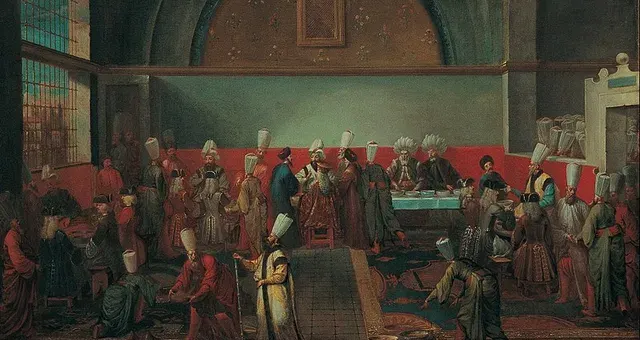
From a regional historical perspective, the Ottoman Empire stands out as one of the first modern empires to institutionalize the table as an instrument of power. Food practices were systematically integrated into governance and diplomatic customs, making shared meals an essential means of political relations and imperial representation. The organization of palace kitchens “the matbah-ı hümayun” illustrates this centralization: hierarchical staff managed precise records of expenses, supplies, and distributions, turning commensality into a political device that structured hierarchies, recognition, and loyalty.
As Tülay Artan, Suraiya Faroqhi, and Amy Singer show, court meals were strictly organized and differentiated according to rank. Whether in diplomatic banquets, ceremonial distributions, or daily meals, the table staged imperial order and produced relations of loyalty and recognition.
Accounts from European ambassadors from years gone by are an invaluable source for understanding how the Ottoman court was perceived by foreigners during negotiations, observations and intercultural comparisons. One such ambassador was Ogier Ghiselin de Busbecq, who served Ferdinand I of the Habsburgs as ambassador to Suleiman the Magnificent from 1554 to 1562. In his Turkish Letters, de Busbecq describes how the spatial arrangement of guests, the strict discipline of service and the absence of free, informal conversation ( offset by the symbolic power of hospitality ) enabled one to assess the disposition of Ottoman power and prepare for subsequent exchanges.
Similarly, the Venetian baili who were Venice's permanent ambassadors in Istanbul from the 15th to the 18th century , explained in their writings how invitations to dine with Ottoman dignitaries served to maintain relations during periods of tension and how an absence of invitation was interpreted as a negative political signal .
Although not places of explicit negotiation, these dinners enabled the balance of power to be gauged, ties to be maintained, and the symbolic recognition essential to diplomatic relations to be produced.
From Ottoman Tables to Modern Cultural Influence
The Ottoman Empire was a veritable transnational culinary matrix, promoting the circulation of dishes, techniques, and table manners throughout the imperial space, from the Maghreb to the Balkans. This long coexistence produced a shared culinary imagination, based mainly on conviviality, abundance, and communal meals.
Even today, Lebanese, Turkish, Greek, Syrian cuisines are immediately recognizable and widely perceived as warm cultural expressions rather than political markers. This depoliticization inherited from the Ottoman space partly explains its contemporary effectiveness as a vehicle for soft power and informal diplomacy.
Lebanon offers a contemporary example with the Tasty Lebanon initiative, launched in 2018 by the Ministry of Economy and Tourism at a time when the country was hit by an unprecedented economic crisis . This campaign aims to promote Lebanese cuisine and mezze culture abroad, and to strengthen the country's cultural image by mobilizing state, semi-public, and diaspora actors. The Lebanese diaspora plays a similar role: through its restaurants and culinary events abroad, it spreads culture, creates familiarity, and forges informal links with foreign audiences. The convivial and seemingly apolitical nature of mezze makes it a particularly effective tool of soft power, allowing Lebanon to project a positive image without resorting to traditional diplomatic channels.
In conclusion, commensality is never truly neutral. Although the mechanisms have changed , from the centralisation of the Matbah-ı Humayun to the decentralised networks of the diaspora , the goal remains the accumulation of symbolic capital. Thus commensality remains a performative act, but its setting has shifted from the Ottoman palace theatre to the global stage, where hospitality is the most sophisticated form of influence.
Bibliography
Artan, T. (2000). Aspects of the Ottoman elite’s food consumption: Looking for “staples,” “luxuries,” and “delicacies” in a changing century. In D. Quataert (Ed.), Consumption studies and the history of the Ottoman Empire, 1550–1922: An introduction (pp. 107–200). State University of New York Press.
Çetin, E. (2023). Examples of culinary diplomacy in late era Ottoman diplomacy. Selçuk Üniversitesi Edebiyat Fakültesi Dergisi, 50, 215–230. https://doi.org/10.21497/sefad.1407743
Cziráki, Z. (2024). The Ottoman court as a special venue for European diplomacy. In D. Goetze & L. Oetzel (Eds.), Early modern European diplomacy: A handbook (pp. 419–429). De Gruyter.
Fischler, C. (2011). Commensality, society and culture. Social Science Information, 50(3–4), 528–548. https://doi.org/10.1177/0539018411413963
Ghantous, R. (2018, August 27). Taste Lebanon. Taste & Flavors. https://www.tasteandflavors.com/taste-lebanon/
Işın, P. M. (2018). Bountiful Empire: A history of Ottoman cuisine. Reaktion Books.
Medina, F.-X. (2021). Looking for commensality: On culture, health, heritage, and the Mediterranean diet. International Journal of Environmental Research and Public Health, 18(5), 2605. https://doi.org/10.3390/ijerph18052605
Smith, W. R. (1894). Lectures on the religion of the Semites: First series, The fundamental institutions. Adam and Charles Black.
The Beiruter. (2025, November 9). Europe falls for Lebanese flavors. The Beiruter. https://www.thebeiruter.com/article/europe-falls-for-lebanese-flavors/411
UNESCO. (2013). Mediterranean diet (Representative List of the Intangible Cultural Heritage of Humanity, Nomination file No. 00884). UNESCO Intangible Cultural Heritage. https://ich.unesco.org/en/RL/mediterranean-diet-00884