A Third Way ? Society 5.0 and the Japanese Model of AI Governance

In recent years, Artificial Intelligence has become a part of our daily lives. It helps us write emails, supports public services, and automates routine tasks. For governments, however, it represents a major strategic challenge : how to promote innovation while respecting social ethics ? Europe’s answer is based on regulation. With the AI Act, the European Commission is trying to respond to massive American investments and set rules for AI. But a key question remains : can we regulate without slowing down progress ? This is where Japan offers a different approach: Society 5.0
As early as 2016, Japan announced its concept of a "super-smart society." The goal was to solve major social challenges, such as an aging population and pollution, through technological integration. The following year, then-Prime Minister Shinzo Abe presented "Society 5.0" at the CeBIT trade fair in Germany. This was intended to position the Japanese model as an alternative to Germany’s Industry 4.0.
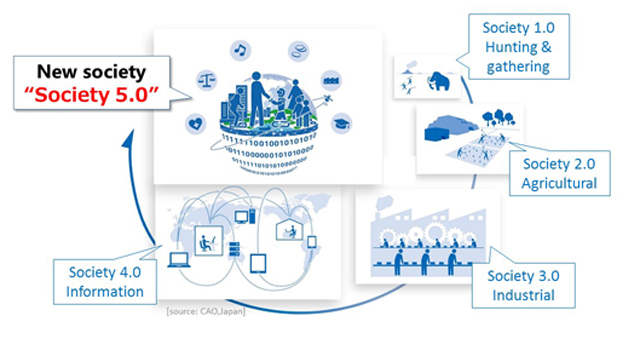
From the information society to the fusion of digital and physical worlds.
Society 5.0 represents a major shift from the "information society" (4.0). In the previous model, systems collected and processed data in isolation for specific needs, such as energy or transport management. Japan is now proposing an integrated system for society as a whole. This new paradigm is based on an iterative cycle : massive amounts of data are collected from the physical world via the Internet of Things (IoT), analyzed by AI in cyberspace, and then sent back into the real world to directly improve our lives.
Unlike Germany's Industrie 4.0, which is limited to modernizing factories, Japanese Society 5.0 seeks to revolutionize public living spaces and habits. The ultimate goal is to achieve such a high degree of convergence that the virtual and the real become indistinguishable, creating a "super-smart" and “human-centric” society as the Japanese government describes.
So what’s this “third way” between the US and China ?
Society 5.0 is more than a domestic policy ; it is a diplomatic tool. Japan positions itself as a "testing ground" for global challenges, such as aging populations and resource management. By exporting these technological solutions, Japan strengthens its international influence, particularly in emerging nations. Furthermore, Japan is actively working to set international standards for data security and AI governance. By promoting this human centric approach, Tokyo offers a strategic third way between American commercial dominance and Chinese state surveillance.
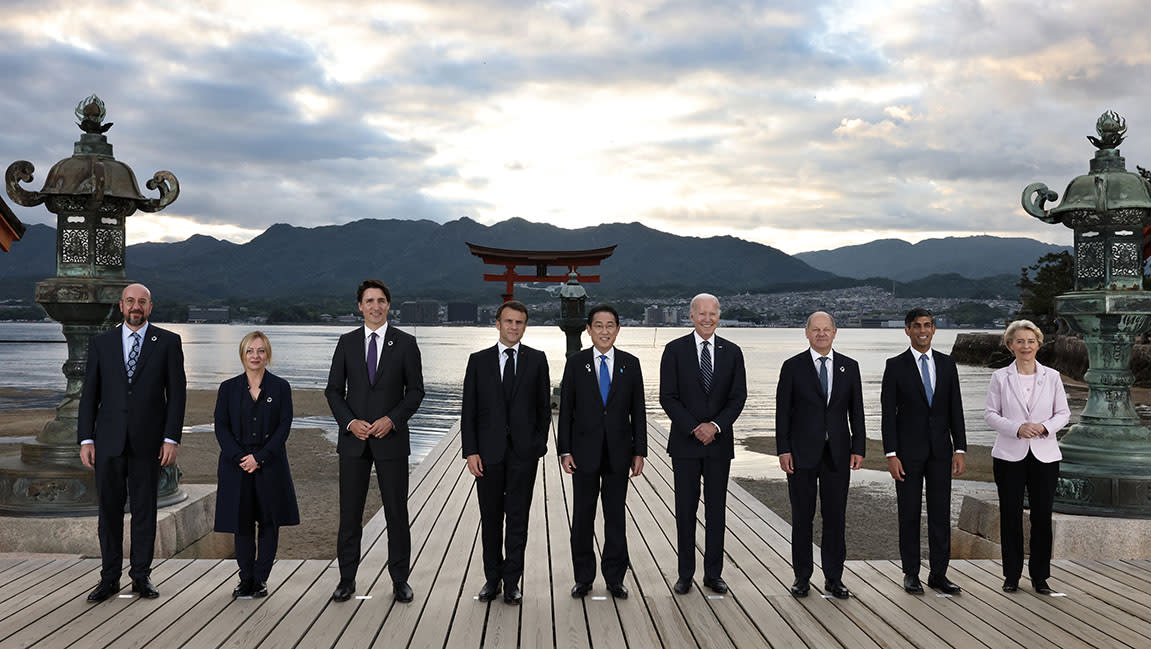
Japan positions Society 5.0 as a strategic alternative to the two dominant models of digital governance. Unlike the American model, which is primarily driven by market forces and profit, or the Chinese model, characterized by centralized state surveillance, the Japanese vision is slightly different. The goal is to prove that a total integration of AI into the social fabric can improve collective well-being without sacrificing individual agency. This position reached the diplomatic stage during the 2023 G7 Hiroshima Summit. Under Japan's leadership, the "Hiroshima AI Process" was launched to establish global guardrails for generative AI while promoting the concept of Data Free Flow with Trust (DFFT). For Tokyo, the objective is clear : to create an international space for data circulation based on mutual trust between democratic nations, opposing both digital protectionism and technological authoritarianism.
Is Society 5.0 a move toward a dystopian society ?
The vision of Society 5.0 is not without its critics. A major concern is the potential loss of human agency. As AI begins to drive decision-making across all sectors, from shopping to urban management, there is a risk that citizens may become passive followers of algorithmic recommendations. Furthermore, the total fusion of physical and digital spaces requires constant, large-scale data collection, raising significant questions about privacy. Japan’s challenge could be to ensure that this "super-smart" society remains truly human-centered, allowing individuals to lead purpose-driven lives rather than simply existing as data points in an optimized system...
Ultimately, Society 5.0 is a bold but fragile project. Japan faces a major problem: it depends heavily on American technology. Whether it is for high-end chips or cloud storage, the digital tools Japan uses are mostly owned by US companies. This makes it difficult to follow a truly independent path. Japan’s choice to use "soft law" instead of strict rules is also a risky bet. By not forcing companies to follow hard regulations, the government is trusting them to act ethically on their own. If this fails, the country could lose control over how AI treats its citizens.
To succeed, Japan must prove that it can protect its human values while using a digital system governed by its allies. Society 5.0 is a difficult balance between a great vision and a (real) lack of technical independence.
SOURCES :
DEGUCHI, Atsushi, HIRAI, Chiaki, MATSUOKA, Hideyuki, NAKANO, Taku, OSHIMA, Kohei, TAI, Mitsuharu et TANI, Shigeyuki (2020), « What Is Society 5.0? », dans DEGUCHI, Atsushi et al. (dir.), Society 5.0: A People-centric Super-smart Society, Tokyo, Springer, p. 1-23.
CABINET OFFICE OF JAPAN (s.d.), « Society 5.0 », Cabinet Office Home Page, [en ligne] https://www8.cao.go.jp/cstp/english/society5_0/index.html
DEUTSCHLAND.DE (2017), « Japan at CeBIT », Deutschland.de, [en ligne] https://www.deutschland.de/en/topic/business/innovation-technology/japan-at-cebit
THE JAPAN TIMES (2025), « Japan to formulate 'AI-first' basic plan to boost industry and safety », The Japan Times, [en ligne] https://www.japantimes.co.jp/news/2025/12/23/japan/ai-first-basic-plan/