Perspectives from Greece’s Permanent Representation on Europe’s Agenda and Key Challenges

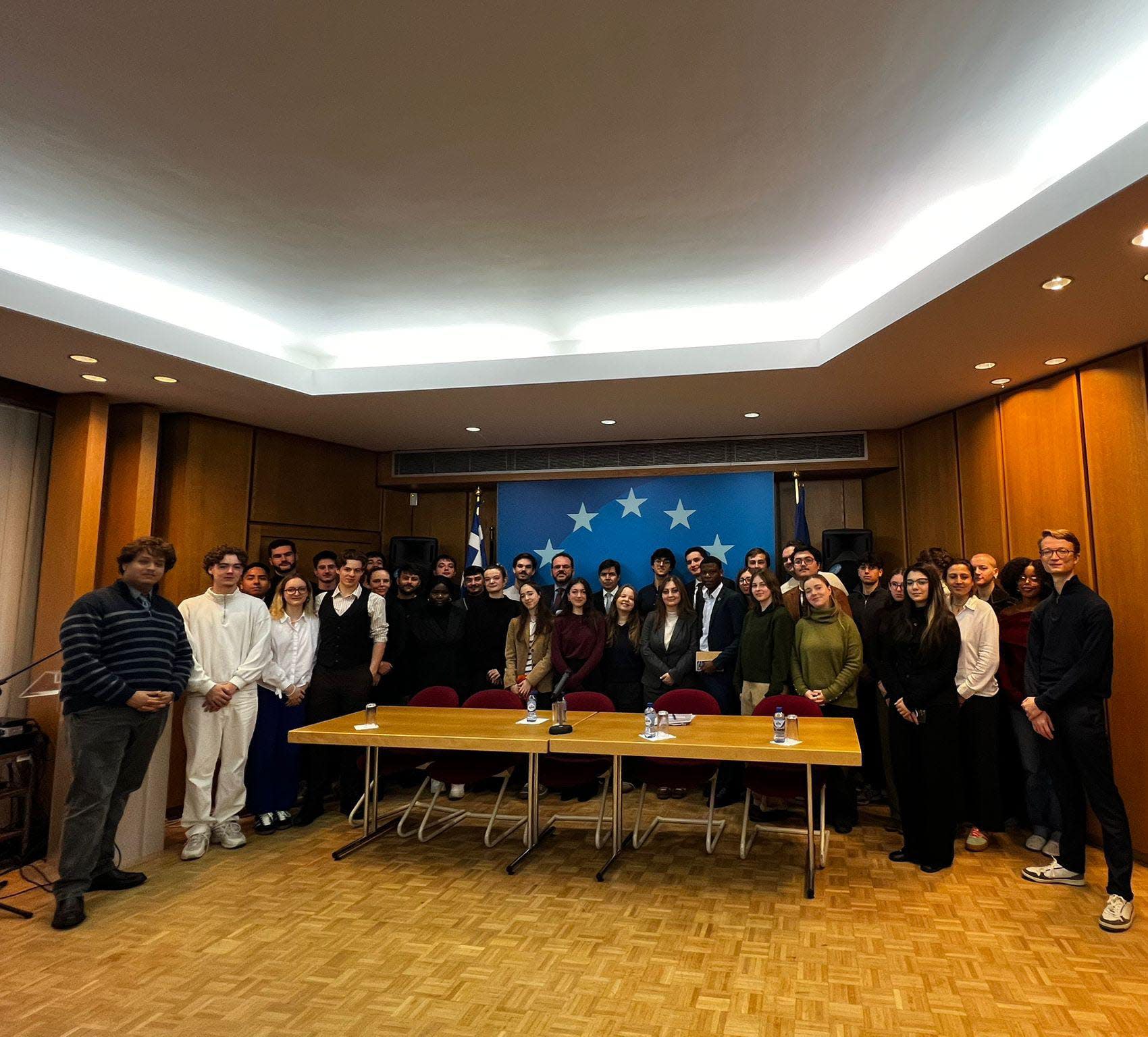
The Comité Diplomatique , accompanied by many participants, has visited the Permanent Representation of Greece to the European Union on Tuesday 18th of November . Greece is scheduled to hold the Council Presidency in the second half of 2027, as part of the trio presidency with Ireland and Lithuania. Consequently the visit provided a valuable opportunity to gain a deeper understanding of Greece’s priorities in advance of its term. Previously, the Comité had also visited the Permanent Representation of Cyprus, which will assume the next EU Presidency. Together, these visits reflect our focus on engaging with countries that are currently holding or are soon to hold the Council Presidency, offering a timely perspective on the EU’s evolving agenda.
Meeting with the Permanent Representative
The visit began with an inspiring conversation with Greece’s Permanent Representative to the EU, Ioannis Vrailas, who opened by sharing his career journey. A former student of European studies at the Université libre de Bruxelles (ULB), his path resonated with many students in the audience pursuing similar studies. Moreover , he has held significant bilateral posts in Tehran and Washington, as well as multilateral positions at the UN, the OSCE, and the European External Action Service . He has represented Greece to the EU since 2020.
Main messages and priorities
During the discussion, Representative Vrailas addressed a wide range of issues reflecting Greece’s positions. He emphasized that the EU must adapt to emerging geopolitical and economic challenges across multiple policy areas. He also pointed out that competition and rivalry between member states needs to be addressed in order to reduce divergences, particularly in defence and foreign policy, which remain largely national competences. Drawing on his experience at the EEAS, he highlighted a pragmatic openness to compromise while expressing a clear preference for unanimity over qualified majority voting in certain Council areas. Thus , he stressed the need to review the EU’s internal working methods to enhance cooperation and coherence among member states.
Multiannual Financial Framework and Competitiveness Fund
Regarding the next Multiannual Financial Framework (MFF 2028–2034), the Commission has proposed a European Competitiveness Fund focused on innovation, technology, and defence. As Vrailas explained, Greece is among the countries advocating for geographically balanced access to this fund, ensuring that all member states, and not only the wealthiest or most technologically advanced, can benefit. Thus , he anticipates prolonged negotiations on this issue and hopes for a positive resolution by next summer, with resources distributed fairly among member states.
Energy, Turkey relations, demographics and migration
On energy, Greece has ambitious plans to become a key European energy hub, although significant infrastructure gaps remain. Regarding relations with Turkey, Mr.Vrailas noted that since his arrival, interactions have been relatively stable compared to past tensions, even though structural issues persist, and he expressed hope for constructive neighbourhood relations in the future. On demographic and migration issues, he highlighted the importance of expanding legal migration channels to reduce dependence on smugglers and traffickers, noting that providing legal alternatives can help curb illegal flows. He also framed migration as a solution to labour shortages, particularly in sectors such as hospitality, and to broader demographic challenges including population ageing and brain drain. On the latter point, he observed a trend of brain gain, with more young professionals returning to Greece thanks to improved job opportunities.
Discussion with the Justice & Home Affairs Coordinator on migration negotiations
In the second part of the visit, the Greek coordinator responsible for Justice and Home Affairs answered a series of detailed questions about the new Asylum and Migration Pact.
To begin with, he explained that the Commission considers Greece, together with Cyprus, Italy and Spain, to be under significant migration pressure. As a result, these countries have been designated as priorities for the assistance provided through the Pact’s solidarity pool. He then stressed the importance of maintaining a fair balance between responsibility and solidarity among member states, and outlined the different solidarity options included in the Pact. He noted that Greece strongly supports relocation mechanisms, which allow asylum procedures and reception responsibilities to be transferred to another member state. This approach helps ease the burden on first-arrival countries and ensures a more even distribution of responsibilities across the Union.
Finally, he described ongoing cooperation with Turkey, including the EU–Turkey joint statement, as well as trilateral coordination between Greece, Turkey and Bulgaria. These three countries meet every two to three months for technical discussions aimed at improving joint management of migration flows.
In conclusion , the Comité Diplomatique warmly thanks the entire Greek delegation of the Permanent Representation, and especially Mr. Ioannis Vrailas, for the time and attention he devoted to us despite a demanding schedule. We were particularly struck by his mindset and his vision of the diplomatic profession: representing one’s country is a genuine privilege, and even under pressure, it is essential to stay open, committed, and to find satisfaction in collective work. He also highlighted how meaningful his role is to him, as diplomatic decisions have a real impact on people’s lives and can genuinely improve everyday realities. This perspective left a lasting impression on the students and offered an inspiring view of what it means to build a purposeful career in service of the European Union.