European Defense Integration : A Realistic Ambition ?

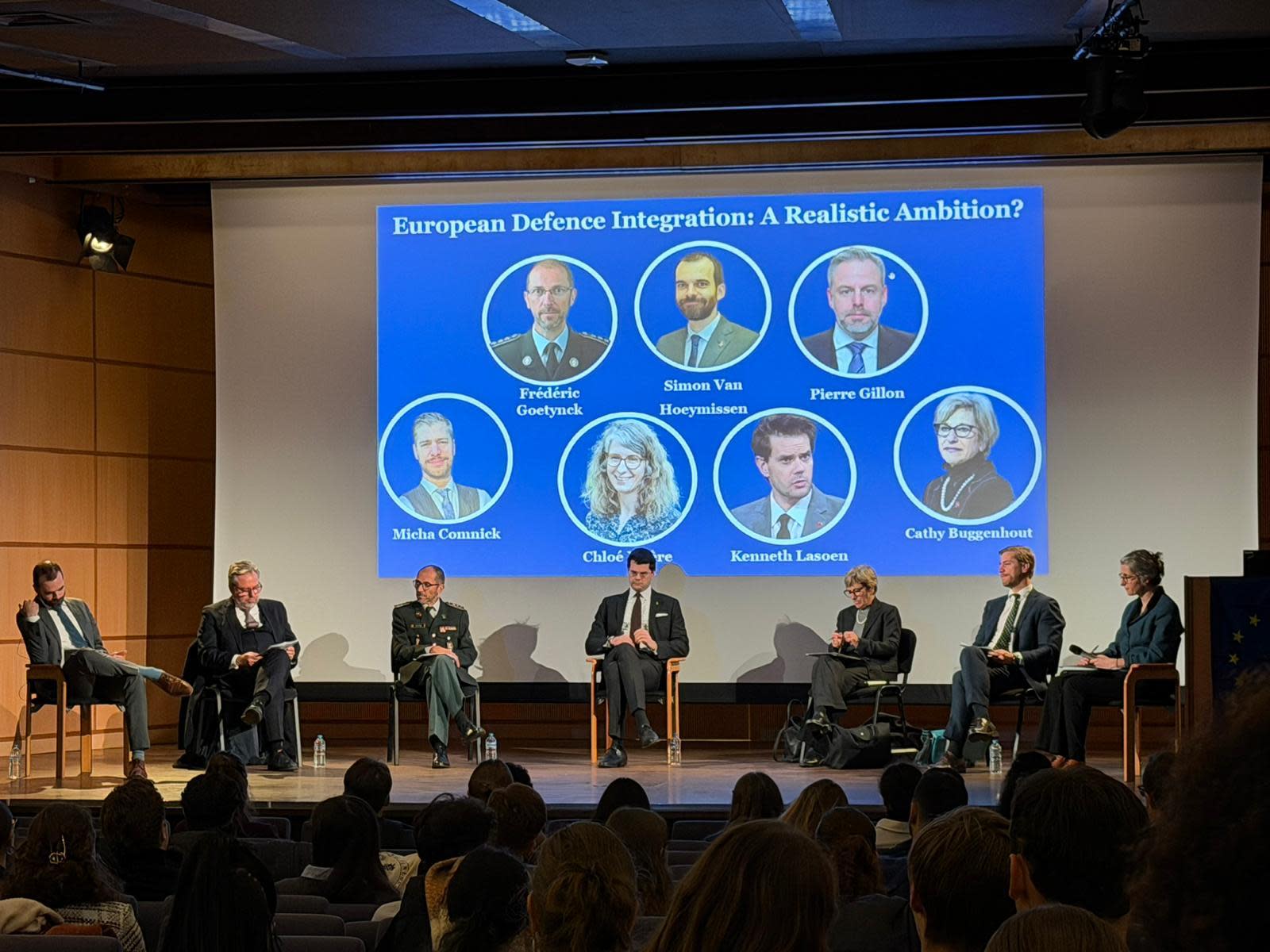
As European security and the integration of defence become central priorities on the EU political agenda, the Comité Diplomatique opened its year with a high-level debate. The conference brought together distinguished guests to discuss the political, financial, industrial, legal and logistical challenges that accompany the drive toward deeper European defence integration; a process in which Belgium plays an indispensable role.
Panel Composition and Contributions
We were honoured to host speakers from a wide range of backgrounds whose perspectives together offered a comprehensive view of the issue. The military and logistics perspective was represented by Vice Chief of Defence (VHOD), Lieutenant‑General Frédéric Goetynck. Two diplomats provided an intergovernmental outlook on European defence: Ambassador Gillon, Belgium’s representative to the EU Political and Security Committee, and Ambassador Buggenhout, Coordinator for EU Defence Industry at the European Affairs Directorate of Belgium’s FPS Foreign Affairs. From the supranational angle we heard Mr Micha Comnick, Assistant to the Director‑General at the European Commission’s Directorate‑General for Defence Industry and Space (DG DEFIS). The legal and academic dimensions were addressed by Professor Chloé Brière, Director of the Institute for European Studies (IEE), and Professor Kenneth Lasoen, Professor of Intelligence and Security Services at the University of Antwerp. The panel was expertly moderated by Simon Van Hoeysmissen, researcher at the Centre for Security and Defence Studies (CSDS) at the Royal Military Academy.
Across three panel sessions, speakers treated defence as a multidimensional ecosystem ( political, military, industrial andlegal ) rather than a narrowly defined military concept.
Between NATO Deterrence, EU Instruments and Hybrid Threats: Understanding Europe’s Defence Ecosystem
To begin , in a more operational interpretation of defence, Lieutenant‑General Goetynck noted that Article 4 of the North Atlantic Treaty has been invoked around 10 to 12 times since 1949, with several consultations since 2020 (notably after the 2022 invasion of Ukraine, consultations following an attack in Istanbul in 2022, and discussions after drone strikes in Poland in 2024). It functions primarily as an instrument to send a strong collective signal when an ally perceives a threat to its territorial integrity or security. Recent consultations have focused on the eastern flank and the Baltic region, which helps explain why parts of the Alliance’s posture (most notably Operation Eastern Sentry) have become heavily eastern‑ and Baltic‑centric. He especially warned that overuse of Article 4 would erode its symbolic significance and political weight. Like Article 5, Article 4 is above all a political tool: its mere existence strengthens NATO’s deterrence. It need not be triggered to be effective; its presence alone reduces the probability of an attack. This deterrent effect remains vital, particularly because NATO combines conventional and nuclear capabilities. The EU, however, does not possess a common nuclear deterrent . On one hand , France retains an independent nuclear arsenal which can politically contribute to European security, but that capability is national rather than an EU‑wide deterrent . On the other hand , the United Kingdom is no longer an EU member .
However , the EU has two related but distinct instruments. Firstly, Article 42(7) TEU obliges Member States to provide aid and assistance in the event of armed aggression. It is mainly a flexible, capacity‑dependent clause that explicitly recognises the role of NATO for those Member States that are Alliance members : the Treaty indicates that NATO remains the foundation of collective defence for those states. Secondly, Article 222 TFEU invokes the Solidarity Clause which triggers EU‑wide solidarity in the face of a terrorist attack or major disaster, and primarily mobilises civilian resources rather than collective military defence. These tools therefore carry political value but do not replicate NATO’s integrated deterrent guarantee or a permanent common military command.
Consequently, Professor Brière emphasised that Article 42(7) does not have the same deterrent force as Article 5. It is more an intergovernmental assistance mechanism that can enable states such as Ireland, through enhanced forms of cooperation, to provide or receive support, but it remains non‑integrated. Crucially, Member States hold diverse positions, and despite those differences each retains significant national capacity to act in hybrid or military crises.
As Ambassador Gillon observed, Europe operates in a grey zone “between peace and war,” characterised by hybrid threats: drones, cyberattacks, infrastructure sabotage and influence operations. These actions typically fall below the Article 5 threshold but impose constant strategic pressure and complicate decision‑making. That context underlines the value of Article 4 consultations, which allow allies to jointly assess ambiguous situations and adapt Alliance posture.
Mr Comnick stressed that Europe’s industrial base is central to crisis resilience: deterrence depends not only on existing weapons but on the ability to ramp up production rapidly. The EU now possesses a toolkit of legal and financial instruments (the European Defence Fund (EDF), the Act in Support of Ammunition Production (ASAP), the European Defence Innovation Scheme, and the recently introduced SAFE mechanism : the Strategic European Armament Act linked to the European Defence Industry Programme / EDIP). These measures rest on distinct but complementary legal bases and enable short‑ and medium‑term action. SAFE, in particular, is conceived in proposals as a flexible, EU‑backed loan facility to finance large, coordinated investments that address critical capability gaps and accelerate industrial scale‑up. Comnick warned, however, that Member State‑level economic capacity remains decisive: many countries face high debt and budgetary constraints, requiring temporary fiscal flexibility and a mix of instruments (loans, guarantees, easier access to EIB financing) to sustain the effort. Without sustained industrial investment, these instruments will have limited impact: absent investment in European production capacity, deterrence and equipment availability will remain inadequate.
Strengthening EU Defence: Economic Constraints, Cooperative Mechanisms and Strategic Autonomy
In a broader understanding of defence, Ambassador Buggenhout underlined that defence is fundamentally about economic interests and competitiveness; European defence capabilities remain constrained by national capacities. Comnick agreed that defence competencies are still largely intergovernmental, even as the Commission deploys new tools to deepen integration in pursuit of a common stance. Tensions persist between Member States’ needs and Commission directives. Speaking for Belgium, Ambassador Buggenhout argued that excessive EU‑level legislation can be counterproductive, hindering rapid innovation investments. For her, the single market which is one of the EU’s greatest achievements has not been fully realised in the defence sector, which is regrettable.
Lieutenant‑General Goetynck reiterated that innovation is essential. More importantly, he noted Belgium’s strong investment in research and development, which gives the country comparative advantage, but stressed that Belgian industry cannot act alone. European partners are indispensable and already collaborate extensively. The urgent challenge is actually about building stockpiles and reserves and today the situation is the opposite, with shortfalls compounded by limited funding. As Ambassador Buggenhout pointed out, Belgium hosts an important, specialised defence industrial base relative to its size , with notable actors such as John Cockerill Defense, FN Herstal, Sonaca and Sabca . However it is not on the scale of the larger European defence industries and lacks sufficient budgetary support.
Professor Lasoen highlighted another underestimated challenge: reluctance among European states to share information. Knowledge‑sharing fosters collective expertise, yet with the current security and commercial sensitivities, protectionist reflexes and even instances of espionage and counterintelligence impede openness.
On European defence cooperation, Professor Brière reminded the audience that calls to “go further” are not new; the current emphasis is on cooperation among willing states. Permanent Structured Cooperation (PESCO), established under Article 46 TEU, remains the principal instrument for deeper collaboration among ambitious Member States. Nevertheless, several states (France, Germany, Italy and Spain among them) continue to apply protectionist practices in defence procurement, often invoking Article 346 TFEU to derogate from single‑market rules on grounds of essential security interests. Repeated reliance on this exception has fragmented the European defence market and generated tensions over capacity‑sharing and procurement procedures. She explained that the Court of Justice of the European Union and the Commission have sought to frame Article 346’s application: case law requires a case‑by‑case assessment and constrains excessive use of the security exception to avoid abusive derogations from EU law. In practice, while these judicial decisions have challenged some national practices, their overall effect has been limited and the Commission has not always pursued many alleged abuses, so the exception remains widely used.
Ambassador Gillon argued that European strategic autonomy is not merely a question of political will: it is primarily a matter of time, investment and industrial capacity. Member States often procure on the market using defence‑adapted public procurement and leverage existing instruments to acquire materiel quickly. A major political obstacle remains the need for unanimity on many foreign and security policy decisions within the Council, which can paralyse collective action. To overcome this, several states including Belgium have promoted broader use of Qualified Majority Voting (QMV) in certain external policy areas.
In conclusion, intergovernmental dynamics do not guarantee cooperation: industrial fragmentation, national protectionism and competition for markets and funding create trust deficits. In short, legal and political instruments exist, but their implementation will depend on concrete efforts to build trust and align national interests.
After a rich debate, participants were invited to ask questions. Midway through the exchange , a fire alarm sounded, interrupting the conference and prompting an evacuation of the building . Perhaps a stark reminder that European security faces constant pressure ? Fortunately, our speakers were maybe accustomed to debating under stress now that crisis management is part of their professional routine.At any rate , the planned reception went ahead afterwards, allowing for informal exchange. The Comité Diplomatique warmly thank the speakers for their generosity , the moderator and attendees, who turned out in good numbers despite the challenging circumstances . We look forward to welcoming you to our next events as it was only the beginning !
This conference was supported by the ULB Cultural Commission (CoCu), the ULB Student Administrators’ Office (BEA), and the Student Office of the Faculty of Philosophy and Social Sciences (BEPSS).