A Visit to the Permanent Representation of Denmark to the EU

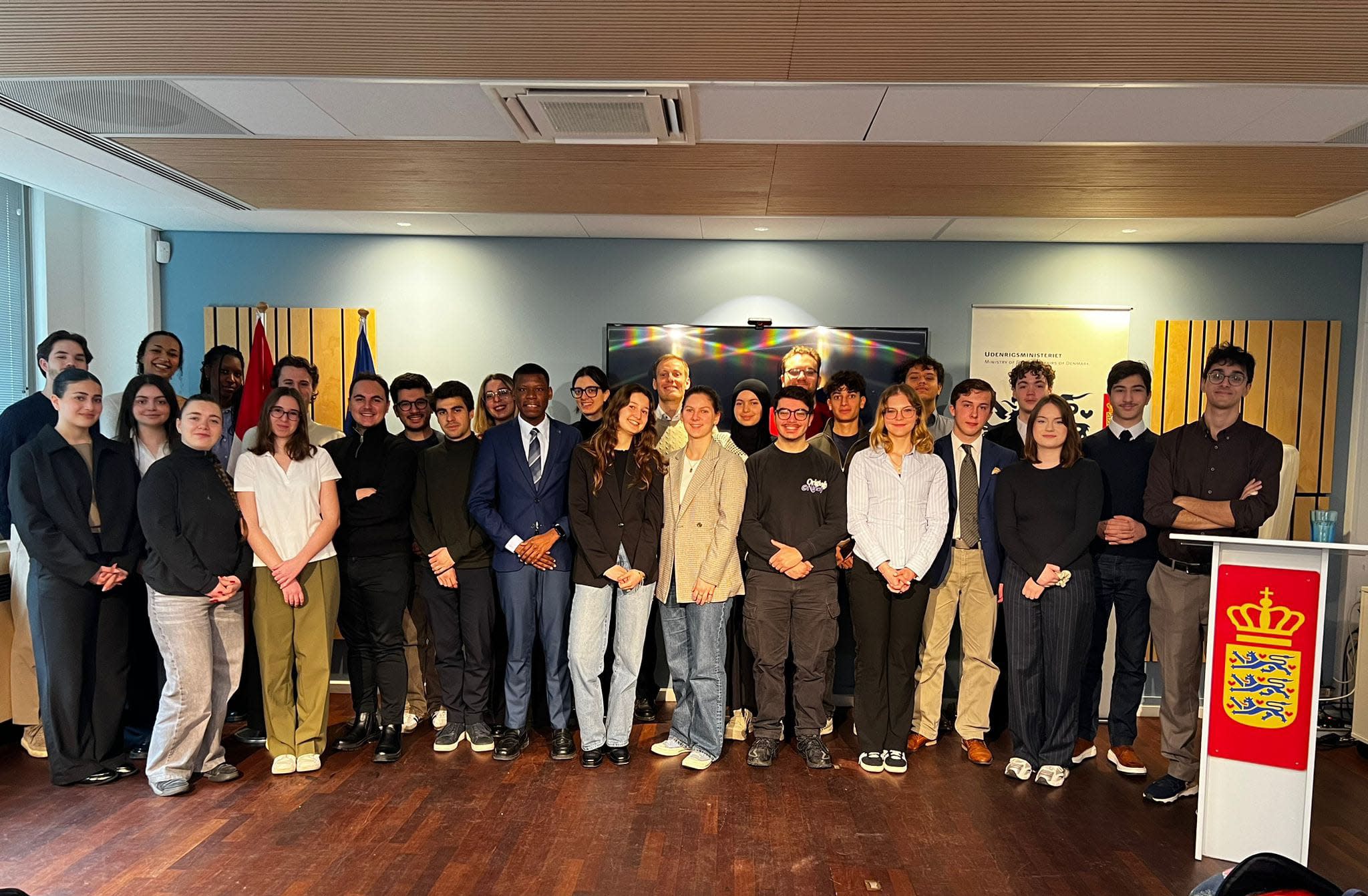
On March 10, the Comité Diplomatique had the chance to visit the Permanent Representation of Denmark to the European Union. The meeting was held with Mr. Anders Arenfeldt Holm, a special attaché representing the Ministry of Industry, Business and Financial Affairs. His role focuses on « simplification » and competitiveness within the EU legislation.
Structure and Functioning
The meeting started with an overview of the Danish Perm. Rep. Mr. Holm specified that the Danish Perm. Rep to the EU is the largest representation of Denmark. During the 6-month-long Danish Presidency, the representation has welcomed around 240 staff members to adjust to the workload. The representation carries out a mini-central administration; each Danish ministry is represented by the special attachés at the Perm. Rep. This administration style makes it a lot easier to coordinate, which is proven to be effective with the Omnibus simplification package that necessitates across-the-board. The expertise of other special attachés on environmental or digital issues helps identify the best advice.
Currently, the Danish government is going through an election cycle, where the elections will take place on 24 March. When Denmark is under election, it has no formal government. Therefore, without a government seat, the work of the Permanent Representation is impacted. The Danish Prime Minister can still attend the European Council meetings, but since she has no formal government, the member states with no formal government typically act more cautiously about being firm and clear in their decisions.
The Role of Council Formations and Trilogues in Maintaining Post-Presidency Influence
Mr. Holm then proceeded to underline the importance of Council formations, specifically the « competitiveness » formation that meets 4-12 times a year. These are some of the most important meetings because they are assisted with the Danish Minister for Industry, Business and Financial Affairs. So, before the meetings, working parties, which Mr. Holm is a part of, thoroughly discuss the laws and proposals for several months before presenting them in the Council formations.
Then, Mr. Holm explained how they keep the « momentum » as a small member-state after the presidency. Firstly, the « Trio » presidency with Poland, Denmark, and Cyprus, a formal agreement to cooperate and lead together, emphasizes an ongoing influence on EU affairs which continues to be the case. Secondly, having just led the presidency for 6 months means both a deepened understanding of the files, and a great network with other agencies, as well as important figures in the Commission.
Another important aspect of leading the Council is the « Trilogues », Mr. Holm explains. Trilogues present a compromise; in the ordinary legislative procedure with two institutions, where the Council and the Parliament can negotiate for an outcome are usually slow and takes time. As a compromise, to speed things up, the two institutions can negotiate in Trilogues and agree that if the Council adopts a text as it is, the European Parliament will not make any amendments and adopt it as it is, which results in a faster process.
After that, Mr. Holm explained their engagement in making Denmark more visible in the EU institutions. To amplify these efforts, one of their goals is to increase the number of staff working in Brussels since Denmark is underrepresented compared to other bigger member states. So, one of their colleagues is specially employed to convince more Danes to come, and they try to promote jobs in Brussels to have more staff representing Denmark.
Danish Strategic Priorities and Policy Positions in EU Affairs
In the Q&A session, Mr. Holm started by underlining the Danish support for Ukraine. Supporting Ukraine and having policy packages concerning Russian Sanctions were one of their top priorities throughout the Presidency. Denmark is the country supporting Ukraine the most per capita, in total sums they are the 4th, showing the willingness of Danes for the Ukrainian cause. The Danish government fully believes that the best measure for European security goes through Ukraine.
Regarding Denmark’s decision not to adopt the Euro as its currency, Mr. Holm assessed this decision as a « symbolic » difference. The Danish currency is more or less linked to the Euro, the Danish currency follows the trend in the Euro’s value, showing there is nearly no detachment between the two currencies. Nonetheless, he outlined that maybe this could potentially be a more significant factor if there are more proposals on common debt.
On the news surrounding Greenland and its future, Mr. Holm highlighted how critical and sensitive the topic is. It’s not only a security or kingdom element, he states. Denmark has faced trade restrictions following the Greenland dispute, targeting specifically Denmark and its trade deals. In the Permanent Representation, Ambassador Carsten Grenbech Jensen is responsible for navigating discussions regarding Greenland. From a practical point of view, all representatives are informed on « lines to take » to show a uniformity in Danish decision-making in formal settings.
Regarding the upcoming MFF package, Mr. Holm stated how the Commission’s focus on competitiveness shapes the agenda. The simplification process, seen as a low-hanging fruit, was regarded as a firm step towards EU competitiveness in the early part of the new mandate. The critical point is to find the balance in EU legislation that can help drive competitiveness with European businesses and markets.
Lastly, regarding Denmark’s relations with Scandinavian and Baltic countries, Mr. Holm explained these states as a « like-minded » group. Specifically, digitalization and competitiveness have been topics on which all these states share a similar view, with states such as Estonia excelling in digitalization.
In conclusion, the meeting focused on assessing Denmark’s 6-month Presidency, policy packages on competitiveness, and the diplomatic tensions. Denmark’s position as a democratic, sustainable, and stable state presents an important aspect of the EU’s future. The Comité Diplomatique firmly thanks Mr. Holm for his presentation and the Permanent Representation of Denmark to the European Union for their warm welcome.