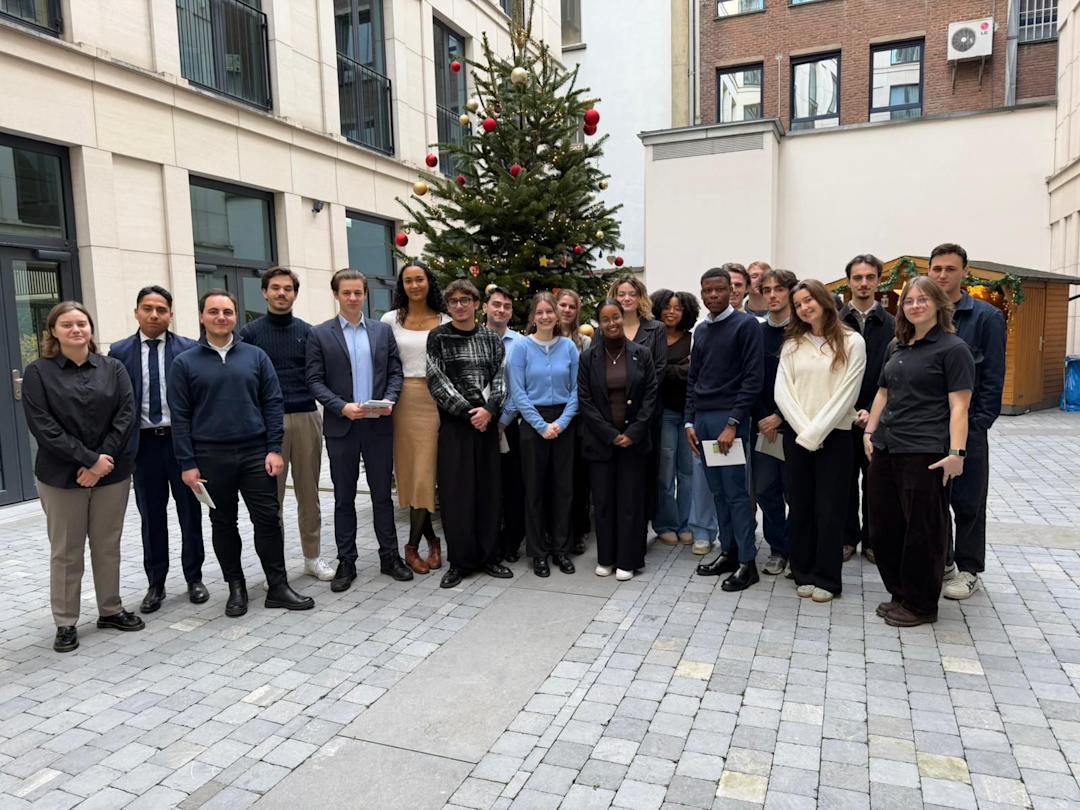
A visit to Taipei’s representative office in the European Union and Belgium

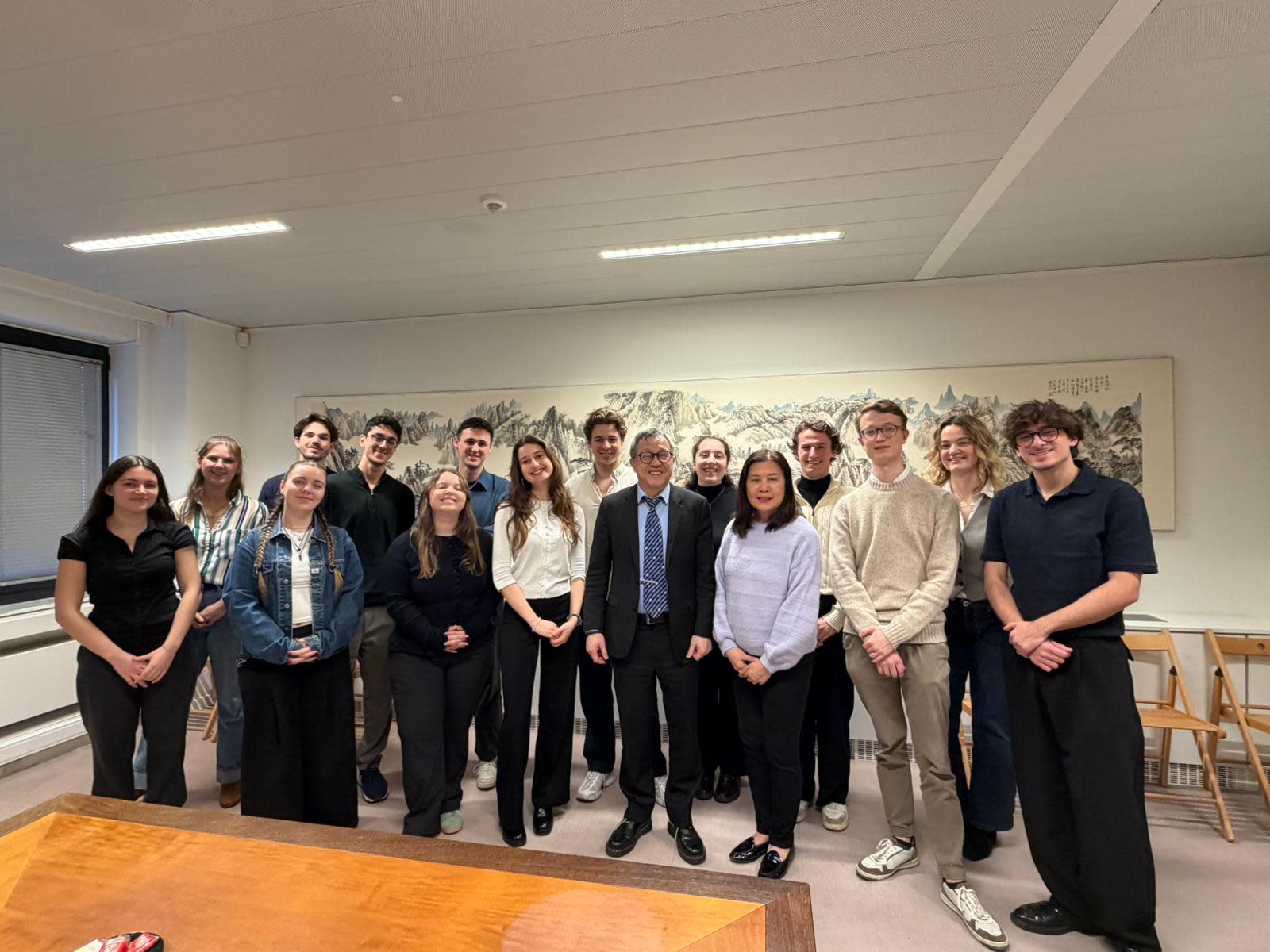
On February 25, the Comité Diplomatique had the opportunity to engage in a lengthy discussion with Shieh Jhy-wey, Taipei's representative to Belgium and the European Union, who has been in office since August 2025. Previously, he served as Taiwan's representative to Germany from 2016 to 2025. During the meeting, several topics were discussed, including relations between Taiwan and the European Union, growing tensions in the Asia-Pacific region, and strategic and geopolitical issues related to the island's situation.
Understanding Taiwan's unique diplomatic status
Taiwan's status is one of the most sensitive geopolitical issues of the 21st century. The island is only officially recognized by a dozen countries, most of which are small, and generally cannot use the name “Taiwan” in its diplomatic representations abroad. To avoid direct confrontation with Beijing, its embassies often bear the name “Taipei Representative Office.” This precaution stems from the position of the Chinese Communist Party (CCP), which considers Taiwan to be a Chinese province and opposes any formal recognition of its sovereignty.
The current situation has its origins in 1949, at the end of the Chinese Civil War. The People's Republic of China (PRC) was proclaimed on the mainland, while the defeated nationalist government took refuge in Taiwan under the official name of the Republic of China (ROC). Since then, Beijing has asserted that Taiwan is an integral part of China and must be reunified.
However, it is essential to emphasize that the PRC has never governed Taiwan. Until 1971, it was the Taipei-based government that represented China at the United Nations. It was only after that date that China's seat at the UN, including on the Security Council, was assigned to Beijing. This diplomatic substitution is at the legal and political heart of the dispute.
The representative strongly emphasized Taiwan's democratic nature. The island has indeed transitioned from a dictatorship, marked by 38 years of martial law, to a democracy that is now widely respected, even though it is not officially recognized as a state by much of the international community.
He pointed out that building a democracy takes time. This political model is viewed negatively by the Chinese Communist Party (CCP), particularly because of the importance it attaches to human rights, such as freedom of expression and freedom of the press. The CCP often argues that these rights are incompatible with Chinese culture, yet the example of Taiwan tends to prove the opposite.
Finally, he emphasized that, despite China's attempts at intimidation over the past decade, Taiwan continues to defend and preserve its democratic system, which appears to be a fundamental value for its society.
The Relations between the European Union and Taiwan
In recent years, the European Union has significantly increased the level of its official exchanges with Taiwan. Taiwanese Vice President Bi-Khim Hsiao's speech to the European Parliament in November 2025 is a powerful symbolic illustration of this. While formally maintaining its “One China” policy, Brussels is developing a more substantial dialogue with Taipei in several strategic areas: defense of democracy, cybersecurity, institutional resilience, the fight against disinformation, and economic cooperation.
This development does not signify formal diplomatic recognition, but it does reflect a pragmatic deepening of relations. The EU is seeking to reconcile two imperatives: preserving its economic relations with Beijing while affirming its commitment to democratic principles and regional stability. For its part, Taiwan expects Europe to provide greater support in international forums, strengthen sectoral cooperation, and coordinate more closely in the face of diplomatic and informational pressure from the Chinese Communist Party.
In the context of European technological sovereignty issues, the European Union is seeking to reduce its external dependence while securing its supply chains, notably through the European Chips Act. In this regard, cooperation with Taiwan appears to be a strategic lever, as the island occupies a central place in the global economy thanks to its semiconductor industry.
TSMC dominates global production of advanced chips, which are essential to many sectors such as automotive, digital, energy, and defense. This concentration of technological capabilities creates a strong interdependence between Europe and Taiwan.
Having served in Germany, the ambassador also mentioned the establishment of a TSMC factory in the country, which marks an important step in technological cooperation between Taiwan and Europe. Although the company is not state-owned and enjoys a high degree of autonomy, its development in democratic countries indirectly contributes to Taiwan's strategic interests. The inauguration of the project in 2024, in the presence of European Commission President Ursula von der Leyen and German Chancellor Olaf Scholz, illustrates the political dimension of this industrial partnership.
From Taiwan's perspective, technological centrality is also a security tool. Global dependence on semiconductors produced on the island reinforces its strategic importance and increases the international cost of any potential conflict. This “power through interdependence” contributes to its resilience in the face of pressure from Beijing. In other words, the technology economy is not only an engine of prosperity, but also a deterrent built into the regional balance of power.
Geopolitical Dynamics in the Indo-Pacific
The stakes go beyond the industrial dimension. A sudden disruption of Taiwanese supply chains would have major systemic effects on European economies. The issue therefore becomes geopolitical: how can critical flows be secured in a context of growing tensions in the Indo-Pacific?
China's military rise is profoundly altering the security balance in East Asia. In this context, Japan recently hinted that it could intervene in the event of a Chinese attack on Taiwan, marking a significant shift in its strategic posture. This statement is part of the strengthening of the alliance between Tokyo and Washington, a central pillar of regional security since the post-war period.
South Korea's position, on the other hand, appears more cautious. Seoul has to deal with the constant threat from North Korea, which sometimes limits its room for maneuver in the strategic rivalries between China and the United States. The South Korean authorities therefore tend to adopt a more measured stance on the Taiwan issue.
But from Taiwan's point of view, the central issue is not only that of direct military support, but also that of strategic coordination between partners. Taipei is seeking to integrate its defense into a broader network including Japan, the United States and, to a lesser extent, Europe. This approach is based on complementarity: American military deterrence, Japanese strategic depth, and European political, economic and technological support. The goal is to make any attempt at Chinese aggression costly, uncertain, and politically risky.
Conclusion
In conclusion, Taiwan’s strategic position rests on three main pillars: democracy, which lies at the heart of its political identity and stands in sharp contrast with China; the semiconductor industry, which gives the island a central role in the global economy thanks to its technological leadership; and its geographical location, at the crossroads of major maritime routes and strategic dynamics in the Indo-Pacific. Together, these three elements explain Taiwan’s economic, political, and geopolitical importance on the international stage.The Comité Diplomatique warmly thanks Shieh Jhy-wey for his engagement and for the richness of the discussions addressed during this meeting.