A visit to the Embassy of New Zealand

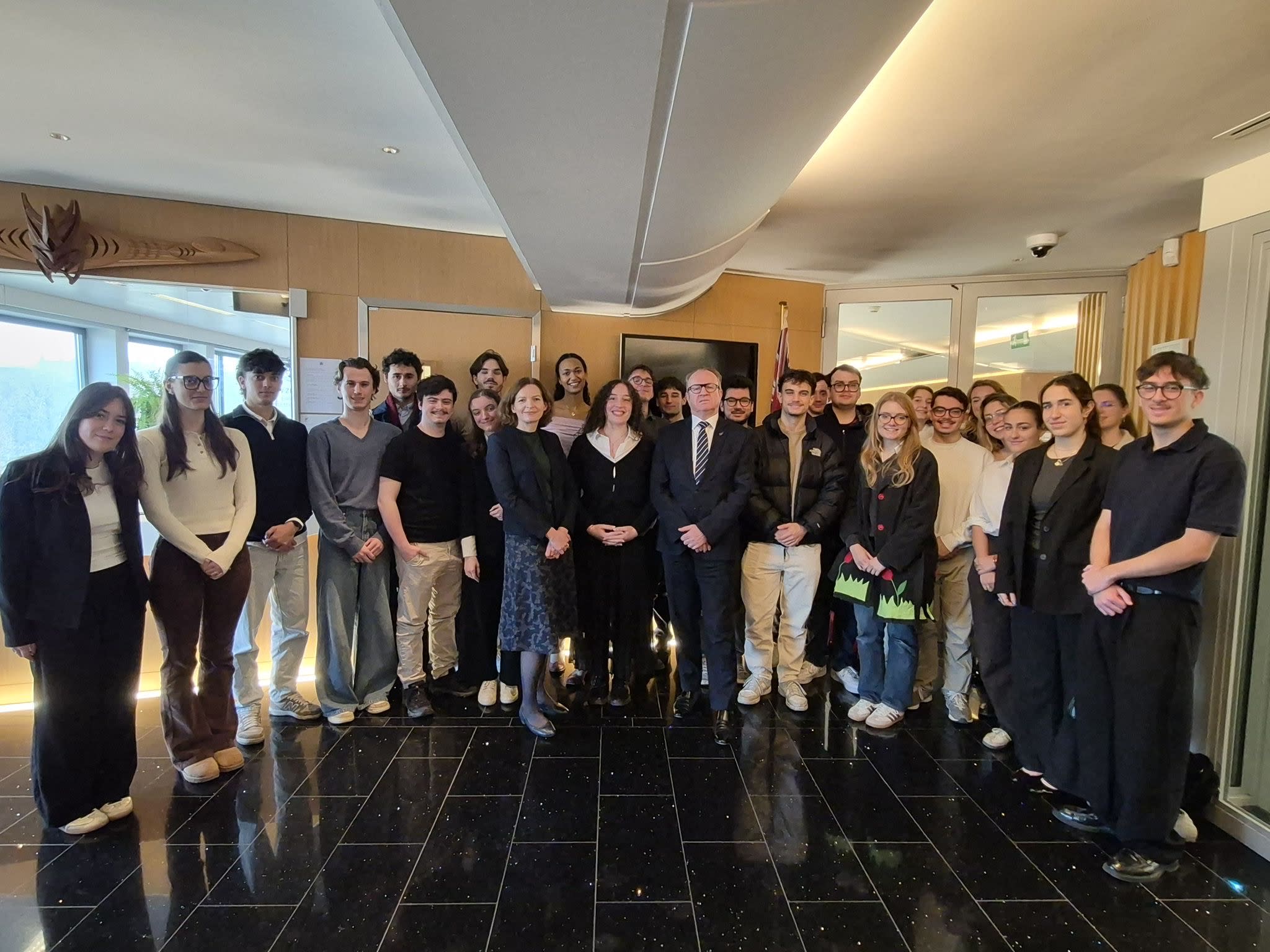
The Comité Diplomatique had the opportunity to visit the New Zealand Embassy for the very first time. We were delighted to be welcomed by Their Excellencies Ambassadors Jennifer Troup and Simon Draper, enabling us to gain first-hand insights into how New Zealand represents its political, economic and environmental interests at the European level and engages with the EU.
Relations between Europe and New Zealand
The relationship between Europe and New Zealand has a unique structure. The ties between the two entities are multifaceted and cover a wide range of areas, including trade, security and scientific cooperation.
Their Excellencies emphasised the long-standing ties that New Zealand shares with Europe, and more specifically with Belgium, by recalling the New Zealand soldiers buried here in Belgium.
Thus, despite the country’s modest size and geographical distance, New Zealand remains involved in European affairs, particularly in terms of defence and security. The country has affirmed its support for Ukraine, with a contribution that at times exceeds that of certain Member States. Thus, even in a geopolitical context marked by numerous security uncertainties, New Zealand regards the European Union as a trusted partner.
Trade issues
Historically, New Zealand’s trade links enabled the country to export 90% of its production to Europe. However, following the United Kingdom’s accession to the European Economic Community in the 1970s, New Zealand lost most of its access to the European market. The New Zealand government was forced to tackle an economic crisis and undertake far-reaching reforms, notably privatisation. Despite the perception of the European Union as a ‘European fortress’ difficult for foreign exporters to access, a free trade agreement was signed two years ago, marking a significant step forward in trade relations. Furthermore, this agreement provides for an annual meeting between the two parties, offering an ideal framework for European-New Zealand dialogue. Far from limiting itself to European exports, New Zealand is gradually diversifying its market by opening trade channels to the United States and Asia, reflecting this small country’s determination to assert itself on the international stage.
The question of identity in New Zealand’s biculturalism
International recognition of New Zealand, and in particular of its people, forms a significant part of its identity. Since the 1960s and 1970s, New Zealand society has undergone profound changes, evolving from a predominantly British population to one of the most multicultural in the world. This population is predominantly made up of the indigenous Maori people, Pacific communities and Asian populations (Chinese, Indian, etc.).
Thus, New Zealand recognises that it is first and foremost defined as a country of immigration, where cultural pluralism is both a source of richness and a diplomatic challenge: namely, how to represent all these identities on the international stage?
For Ambassador Simon Traper, representing New Zealand necessarily involves representing the partnership with the Māori. Indeed, the country defines itself today not primarily as a fundamentally multicultural nation, but rather as a bicultural one. This partnership is notably embodied in the Treaty of Waitangi (1840), signed between the British Crown on one side and the Māori on the other. Today, the peaceful recognition of Māori culture, and in particular its influence on the economy, politics and language, contributes to New Zealand’s global standing. The country therefore refuses to sign any international treaties or agreements that would deny the influence and role of the Māori people.
In light of this stance, Their Excellencies ask: might Europeans not have lessons to learn from the model of relations between New Zealand and the indigenous Māori people?