A Visit to Canadian Embassy to Belgium: Geopolitical Perspectives of a Steady Giant

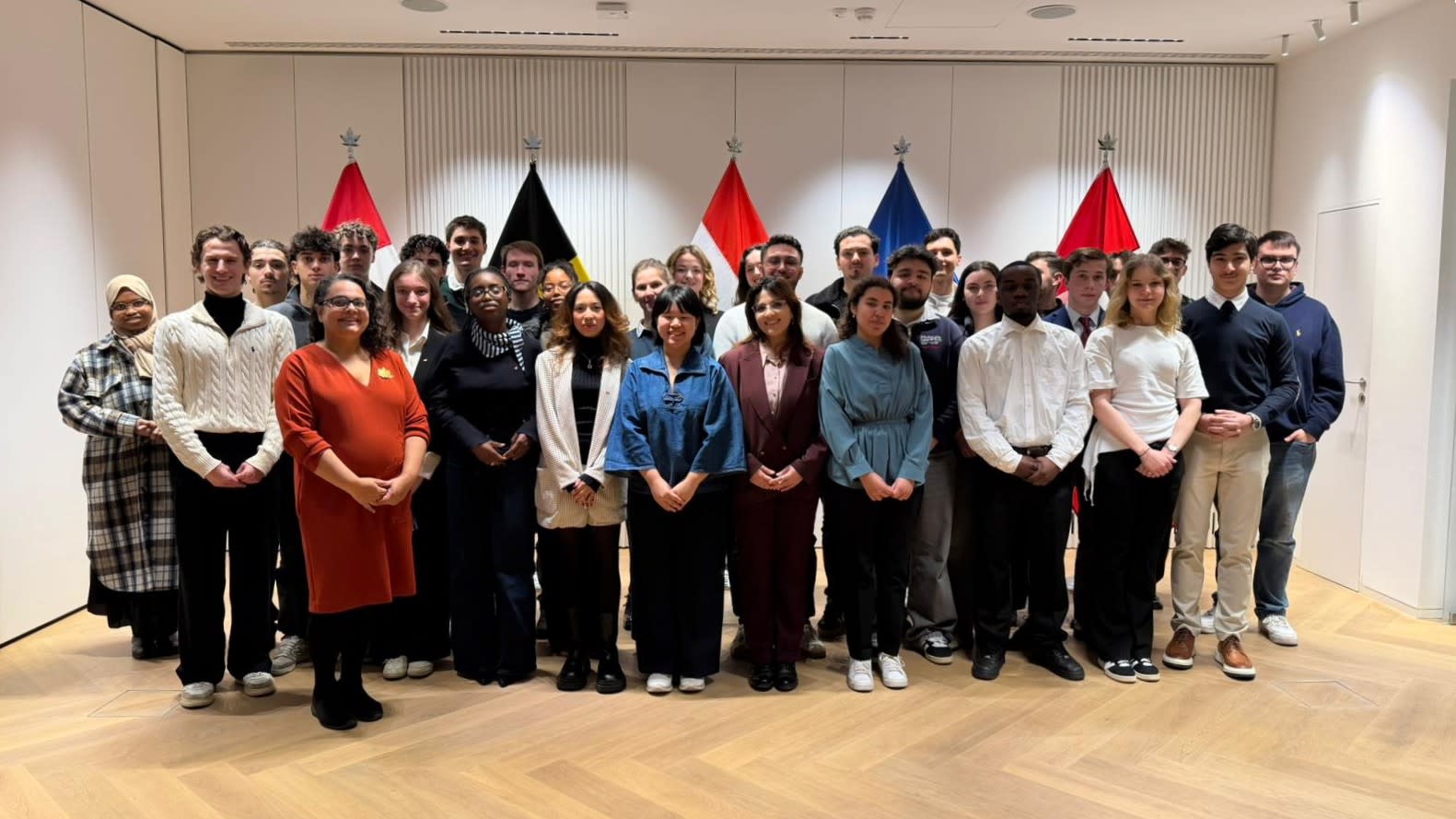
On Monday, March 16, 2026, we had the opportunity to visit the Canadian Embassy in Belgium during an event co-organized with the ULB’s SPECQUE delegation. We were warmly welcomed by Ms. Ritika Nandkeolyar, the embassy’s political advisor, who is responsible for public, economic, and political affairs.
Canada in a Changing Geopolitical Landscape
Canada currently finds itself in an interesting geopolitical context, leading it to cooperate in many sectors with partners who share its values, such as the European Union. In terms of trade, for example, the CETA (the free trade agreement between the EU and Canada) facilitates extensive cooperation with the EU in this area. In this regard, Ms. Nandkeolyar emphasized that Belgium is a key trading partner for Canada, particularly because it is situated at the gateway to Europe. However, since Belgium has not yet ratified CETA, the volume of trade between the two countries could still be increased. In the energy sector, Canada also collaborates with its European partners, particularly Belgium. It is worth noting that the G7’s first Small Modular Reactor (SMR—a new type of nuclear reactor) will be implemented in Canada, in the Toronto region. Furthermore, it maintains privileged bilateral relations with Luxembourg, particularly regarding the financial sector. The first European campus of McGill, the renowned university in Montreal, has opened in Luxembourg to offer a specialized program in this sector. Higher education is also a key area of cooperation with other countries, notably with India, the leading source country for international students studying in Canada.
The current geopolitical context is also leading them to cooperate more closely in the defence sector, for example by becoming the first non-European country to join the Security Action Plan for Europe (SAFE), a new instrument designed to provide financial support to member states in order to accelerate defence preparedness. In addition, Ms. Nandkeolyar emphasized the importance of NATO’s role as a forum for international discussion, which fosters mutual understanding and enables the joint development of legitimate solutions. Like Belgium, Canada was once a “bad student” within NATO and has since increased its defence spending, particularly on military infrastructure, new equipment, and salaries to attract new recruits.
“Canada is the US’s largest customer, and the US is Canada’s largest customer”
Despite the emergence of tensions, Canada maintains a special bilateral relationship with its only land neighbour, the United States. Indeed, following US statements regarding Canada’s sovereignty, Canadian citizens were less inclined to purchase American goods and to use their vacation homes in the south of the US, which had a significant economic impact on them. However, the United States remains and will continue to be Canada’s primary economic partner. As Ms. Nandkeolyar explains, “Canada is the US’s largest customer, and the US is Canada’s largest customer.” Relations with the U.S. are not merely economic but also hinge on the pivotal role the United States plays on the international stage. Canada thus seeks to act as a sort of “balancing force,” striving to inform US decision-making as effectively as possible.
Promoting French internationally and in diplomacy
As an officially bilingual country, Canada has English and French as its official languages, the promotion of which on the international stage is a priority. Accordingly, it has submitted its bid to host the next Francophonie Summit in 2028. Furthermore, Ms. Nandkeolyar also emphasizes that it is important for everyone to be able to express themselves in their own language and, consequently, that the role of translators and interpreters is significant, whether at the international or domestic level. Indeed, without them, speakers of the predominant language, English, could dominate and even control discussions. Furthermore, Canada also supports the OIF’s initiative regarding the training of LLMs (Large Language Models—the technology underlying the operation of AI models such as Claude.ai or ChatGPT): Since these models were trained exclusively in English, they perform better in that language than in others. They should therefore be trained in French, as well as in all other languages, so that their performance is consistent across the globe.
We would like to warmly thank the Canadian Embassy, and in particular Ms. Nandkeolyar, for hosting us and presenting these fascinating aspects of Canadian diplomacy.