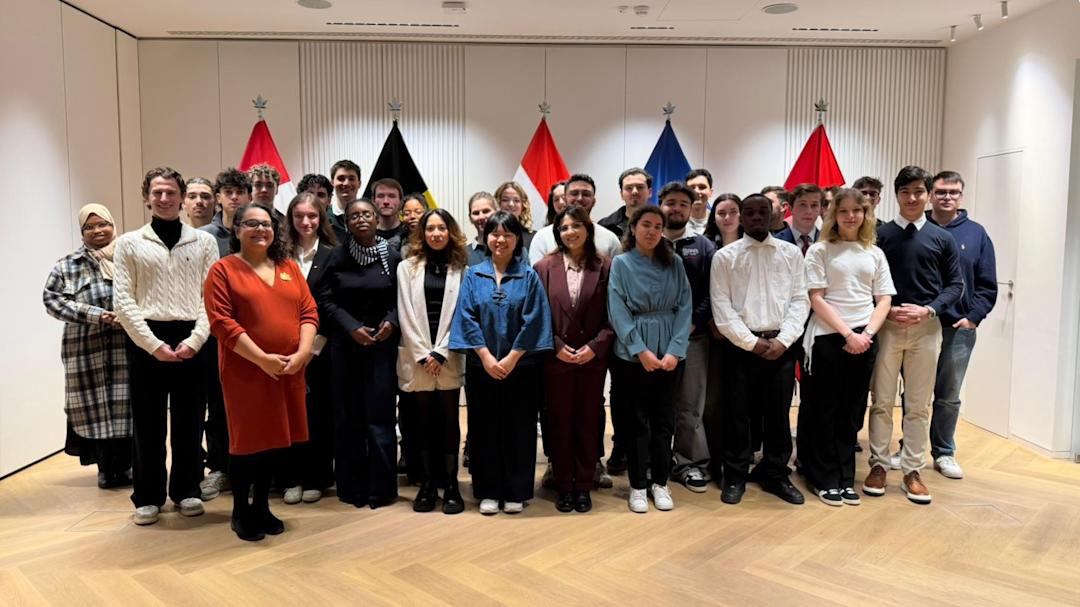
A visit to the Brazilian Embassy in Belgium

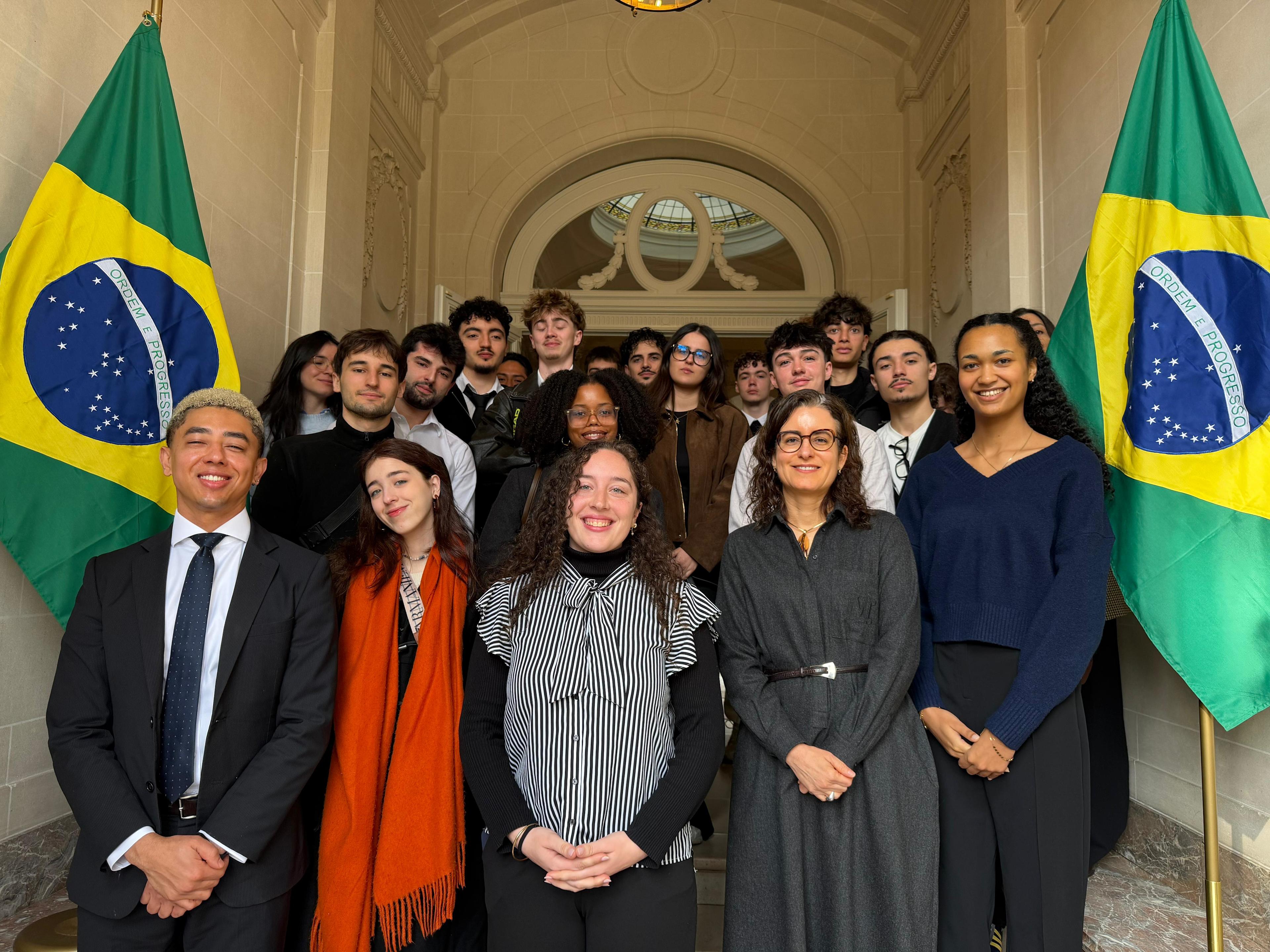
The Comité Diplomatique had the opportunity to visit a South American country for the first time: Brazil, whose embassy has recently been renovated and whose staff has been refreshed. Ms. Ana Luiza Membrive Martins, Minister-Counselor, and Mr. Jonathan Assis Paz Braga, Head of the Trade Promotion Section, gave us insight into Brazil’s foreign policy and its role in the global order, as well as its relations and interests with Belgium and the EU.
The Pillars of Brazilian Foreign Policy
Brazil’s foreign policy is based on three key principles enshrined in its Constitution: universalism, pacifism, and pragmatism. As a “middle power,” the country favors an approach based on dialogue and cooperation rather than military intervention.
The principle of non-intervention is central. Brazil consistently promotes diplomatic solutions and multilateralism to resolve international crises. As a founding member of the United Nations, it advocates for an international system based on collective negotiation of global issues.
Since 2023, the country has made a strong comeback on the international stage, notably by hosting summits for numerous multilateral forums such as the G20 in Rio de Janeiro in 2024, the COP in Belém in 2025, and the BRICS summit that same year. This momentum is in line with its priorities: fighting poverty and hunger, combating climate change, and modernizing global governance. In this regard, Brazil advocates for reform of the United Nations Security Council to make it more representative of current global balances.
Consistency and Pragmatism in Brazil’s Global Strategy
When asked about the impact that Jair Bolsonaro’s administration may have had on foreign policy, Ms. Ana Luiza Membrive Martins stated that Brazil’s foreign policy is fundamentally stable over the long term and characterized by continuity. While each government sets its own priorities and pushes its own agenda, the broad policy directions remain stable, with a consistent commitment to multilateralism.
In a shifting international landscape, the Minister-Counselor asserts that Brazil positions itself as a reliable and impartial actor. It maintains diverse relationships: China is its main trading partner, while the United States remains a major investor. Europe and Latin America also occupy a central place in its strategy.
Faced with contemporary challenges ( social inequality, development, and climate change ) Brazil seeks to actively contribute to global solutions. Despite some criticism of its sometimes contradictory environmental commitments, the authorities remain confident in their ability to achieve their climate goals.Brazil’s experience in the energy sector, particularly with oil and ethanol programs, illustrates its pragmatism. The country is striving to balance resource exploitation with the energy transition.
A Pragmatic Approach to International Crises
From a geopolitical perspective , Bresil’s presidency of the United Nations Security Council at the time of the events of October 7 highlighted its priority: humanitarian action and the promotion of dialogue. Even in complex contexts involving strategic partners such as Iran, Brazil maintains a diplomatic approach focused on negotiation and dialogue.
Brazil has expressed "deep concern" over the March 2026 U.S.-Israel attacks on Iran, urging maximum restraint and warning that the escalation could worsen regional stability. Although immediate local impacts are considered limited., in the long term the crisis can threaten Brazilian trade, forcing agricultural exporters to reroute shipments in the Middle East, while the government monitors inflation and logistics costs .
Close economic and trade ties with Belgium and Europe
The Brazilian Embassy in Belgium also covers Luxembourg. Historically, these ties have contributed to Brazil’s industrialization and continue to grow stronger today, particularly through investment.
Relations between Brazil and Belgium are rooted in a long tradition of cooperation dating back to the 19th century, shortly after the independence of both nations. Today, they are based on shared values as well as extensive economic exchanges and investment flows, which form the basis for regular dialogue between the two countries. From the early 20th century onward, Belgian companies played a significant role in Brazil’s industrial development, particularly in the steel sector, with pioneering projects such as the Belgian-Mineira Company, founded in 1921.
This historic cooperation continues today to underpin strong bilateral relations. Brazilian companies and products are already well established in Belgium, such as Citrosuco’s orange juice and aircraft from manufacturer Embraer. The export promotion agency Apex also plays a key role in the development of economic exchanges.
The EU-Mercosur agreement, ratified by the Brazilian Senate in March 2026, is another pillar of this cooperation. Although the agreement with the European Union is still the subject of debate and criticism on both sides , particularly regarding the balance of concessions, Brazil views it as an important tool for enhancing trade predictability and stimulating long-term investment.
Brazilian Soft Power: Cinema as a Tool of Influence
Brazil is also expanding its influence through soft power by highlighting its cultural richness. During the discussion, Ms. Ana Luiza Membrive Martinsa presented cinema as an important tool for international outreach, driven by the release of new films that help revitalize the country’s image abroad.
Recent films such as Kleber Mendonça Filho’s The Secret Agent, presented at Cannes and widely acclaimed, or Walter Salles’s I’m Still Here, an Oscar winner, illustrate this renewal. Alongside these major productions, works such as Manas shed light on profound social realities, particularly in the Amazon. This dynamism reflects a committed film industry capable of addressing historical and contemporary issues while reaching an international audience.
This cultural presence complements other vectors of influence such as fashion, gastronomy, and the artistic vitality of Brazil’s major cities. Brazilian soft power thus rests on a pluralistic, creative, and modern identity, sparking interest far beyond its borders.
The presence of a significant Brazilian diaspora in Belgium (approximately 50,000 people) and Luxembourg (nearly 10,000) also constitutes an essential vehicle for cultural dissemination and bilateral ties.
We would like to thank the Brazilian Embassy once again for organizing this exchange despite their busy schedule.