Women in International Affairs

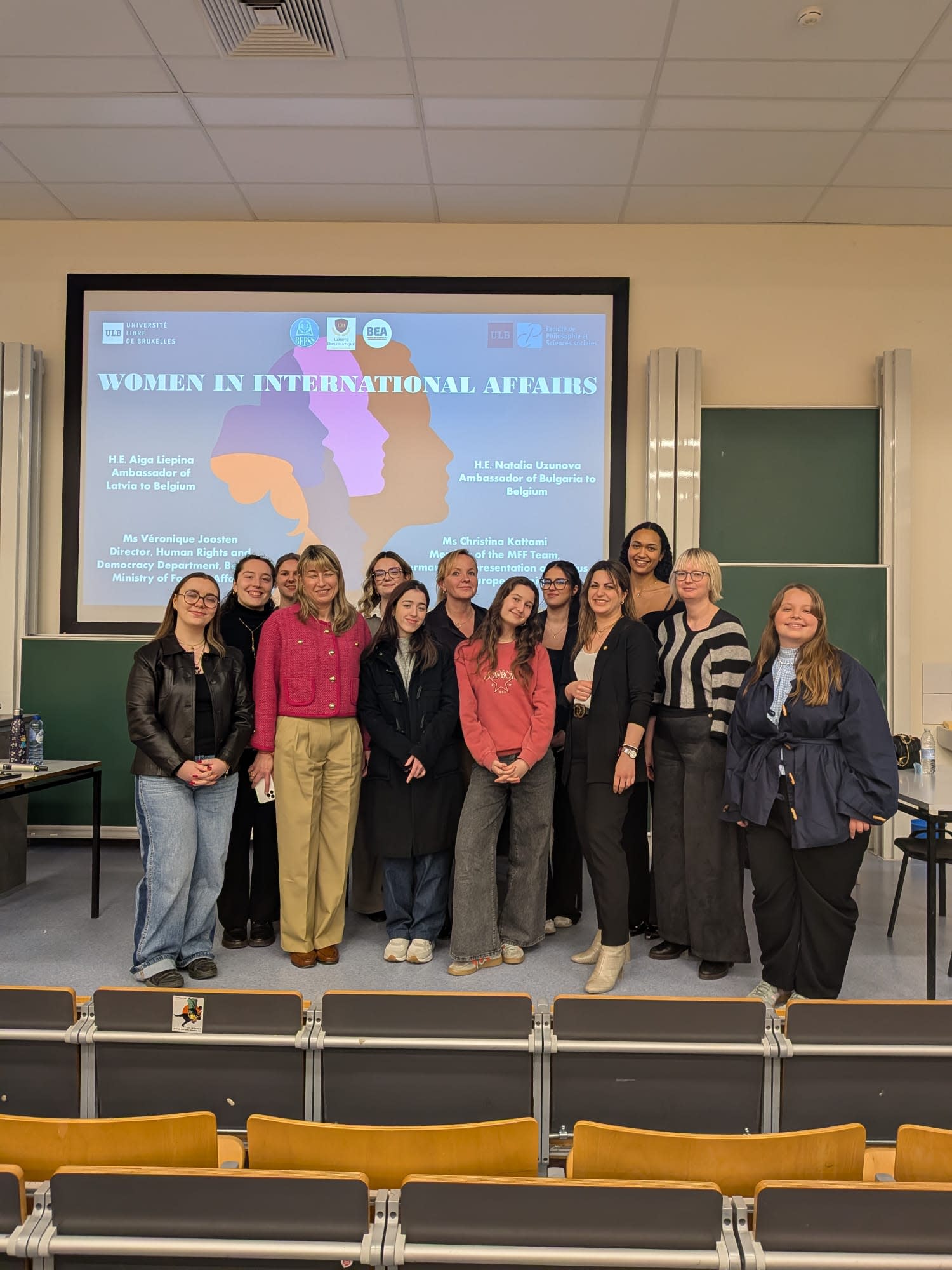
To mark Women’s Rights Month, the Comité Diplomatique organised a conference entitled “Women in International Affairs” on Thursday, March 5. The event , moderated by Clara Moisan and Juliane Denis, two members of our editorial team , aimed to reflect on the progress made toward gender equality in world politics , as well as the structural obstacles that women still face throughout their career in diplomacy, European institutions, and foreign ministries.
To this end, we had the honour of hearing inspiring testimonials from four distinguished guests from a variety of professional backgrounds: H.E. Ms Aiga Liepiņa, the Latvian Ambassador to Belgium; H.E. Ms Natalia Uzunova, the Bulgarian Ambassador to Belgium and Luxembourg; Ms Christina Kattami, a European Commission official specialising in EU economic policy; and Ms Véronique Joosten, the Director of Human Rights at the Belgian Ministry of Foreign Affairs.
The Latvian ambassador won everyone over with her 'water bottle' metaphor. Essentially, it involves imagining a bottle filled with people at various levels within an organisational hierarchy. At the bottom, there are many women in junior or mid-level positions. As one moves up the hierarchy towards the middle of the bottle, the number of women decreases. Finally, at the narrow neck of the bottle, only a few reach the highest positions, such as ambassadors, ministers or executives. The narrow neck of the bottle thus symbolises the fact that, even though many start out, very few reach the top.
In debates on gender equality, this metaphor is used to demonstrate that, although women may be well represented in a given sector, they remain underrepresented in positions of power. Therefore, the problem concerns not only access to the profession, but also the ability to advance to the highest levels of responsibility.
Indeed, she presented her country as a role model for equality, highlighting the significant presence of women in public life. For example, the Minister for Foreign Affairs is a woman, as are many other key figures, setting an example for other states to follow. She also recalled her time in Strasbourg as Latvia’s permanent representative during the adoption of the Istanbul Convention in 2011 ; a Council of Europe treaty designed to prevent and combat violence against women and domestic violence.
H.E. Ms. Natalia Uzunova offered us a unique insight into European diplomacy, particularly into the workings of COREPER, the Committee of Permanent Representatives of the European Union, which is the driving force behind European decision-making. She describes an environment that is rather competitive, exhausting, and emotionally intolerant, where the “boys’ club” mentality is still very much alive. Furthermore, gender norms are quite prevalent there; women must always be available and meet very high expectations. Their assertiveness in negotiations is also less tolerated, which requires specific behavioral strategies.
Even though women are more present, this is more of an evolution than a revolution : it is a slow but real progression. However, in times of crisis or war, the decision-making process becomes very masculine again, and the changes observed therefore remain fragile.
After working at COREPER, Uzunova was promoted to her country’s ambassador to Belgium, but she quickly discovered the reality of working in Brussels and of bilateral diplomacy, where power is often theatrical and highly hierarchical. As a single mother, she had to navigate complex professional and personal choices. Ambassadors’ visibility reinforces their legitimacy, but certain social circles have long excluded women, making it difficult for them to integrate. According to her, successful women tend to develop coping strategies, learning when and how to adapt in order to maintain their influence
For her, change is not limited to increasing the number of women in leadership positions. The system must also adapt to women, and their role is not merely to fit into existing structures but to help modernize European diplomacy. This includes transparency, generational renewal, and more open institutional practices. Cultural change is not solely a matter of gender: it also reflects how institutions are evolving in their internal operations.
Ms Kattami spoke openly about the experiences that have had a profound impact on her, emphasising our ability as women to make our own choices. Reflecting on her academic journey in economics, a field with a particularly pronounced gender imbalance of around 70% men and 30% women . She noted that these ratios were also reflected in academic performance, with men predominantly achieving the highest scores.
She questioned certain grading mechanisms, particularly negative marking, which penalises more cautious students. According to her, women, on average, take fewer risks in their answers, creating a structural bias in the results. Therefore, the system, which appears neutral, produces different effects depending on gender.
The early years of her career at the European institutions, particularly at the Commission, were characterised by heavy workloads. Working under the leadership of a French supervisor whom she remembers very fondly, she found herself juggling two highly demanding roles in a pressurised environment. She had built up an image of herself as a strong, hard-working woman who never gave up or cracked under pressure. However, one evening, in front of her director, she broke down in tears, overwhelmed by the mental strain of her work environment. Her superior acknowledged his mistake in failing to notice the organisational flaws that may have contributed to this situation.
At first, she experienced it as a humiliating moment that shattered the image she had built for herself; however, a central part of her story hinges on a shift in perspective. A friend pointed out to her that her ability to support her colleagues was, in fact, a strength. Her vulnerability became a resource, a tool for building relationships in an often-uncompromising environment.
This line of thinking leads her to question the idea that change must necessarily come from institutional structures. In her view, the transformation also involves inner work, such as redefining the standards of success and the qualities that are valued. This idea forms part of a broader reflection on empowerment ,both individual and collective , and on how women can reclaim control of their life paths in constrained environments. Ultimately, change comes from within.
She also touched on a broader discussion of European policies and their practical tools. She highlighted the role of the multiannual financial framework, structured over a seven-year period, as a key lever for guiding policy priorities and translating commitments into tangible actions.
In this context, she emphasizes the need for Member States to demonstrate the real impact of allocated funding, prioritizing a so-called “bottom-up” approach based on needs and on-the-ground realities. She illustrates this requirement through several examples: Estonia’s development of a tool to measure gender gaps; initiatives implemented in Italy to combat homelessness; and actions taken by the European Union to promote women’s participation in peace processes in Africa.
Finally in her remarks, Ms. Joosten reflected on her experience of human rights negotiations. She points out that, in practice, these negotiations are particularly demanding and can be very tough, despite often being viewed as a 'soft' area of diplomacy. She describes the long hours of work and late-night discussions required to reach compromises, and notes that many of the diplomats involved in these negotiations are men. In her view, it is dangerous to take advances in human rights for granted; they must continually be defended. With this in mind, the Belgian Ministry of Foreign Affairs has begun implementing specific training programmes to address the rise of anti-gender movements, which are now a major concern. She also mentions events and initiatives organised around the Women, Peace and Security agenda, which aim to maintain political and diplomatic attention on women’s participation in peace processes, as well as on the protection of their rights in international contexts.
In conclusion, it is encouraging that a significant number of men attended the conference, which the speakers found particularly positive, as this was not necessarily the case in the past. While progress may be slow, it is undeniably happening. However, these advances must be actively preserved and should not be taken for granted.
We would like to warmly thank the speakers for powerfully championing the cause of women through their insightful reflections and inspiring conclusions drawn from their experiences. The event concluded with an informal reception, providing an opportunity to continue the discussion with the speakers in a more relaxed setting.
This conference was supported by the ULB Student Administrators’ Office (BEA), and the Student Office of the Faculty of Philosophy and Social Sciences (BEPSS).