Regional diplomacy in action: a visit to the Representation of North Rhine-Westphalia to the EU

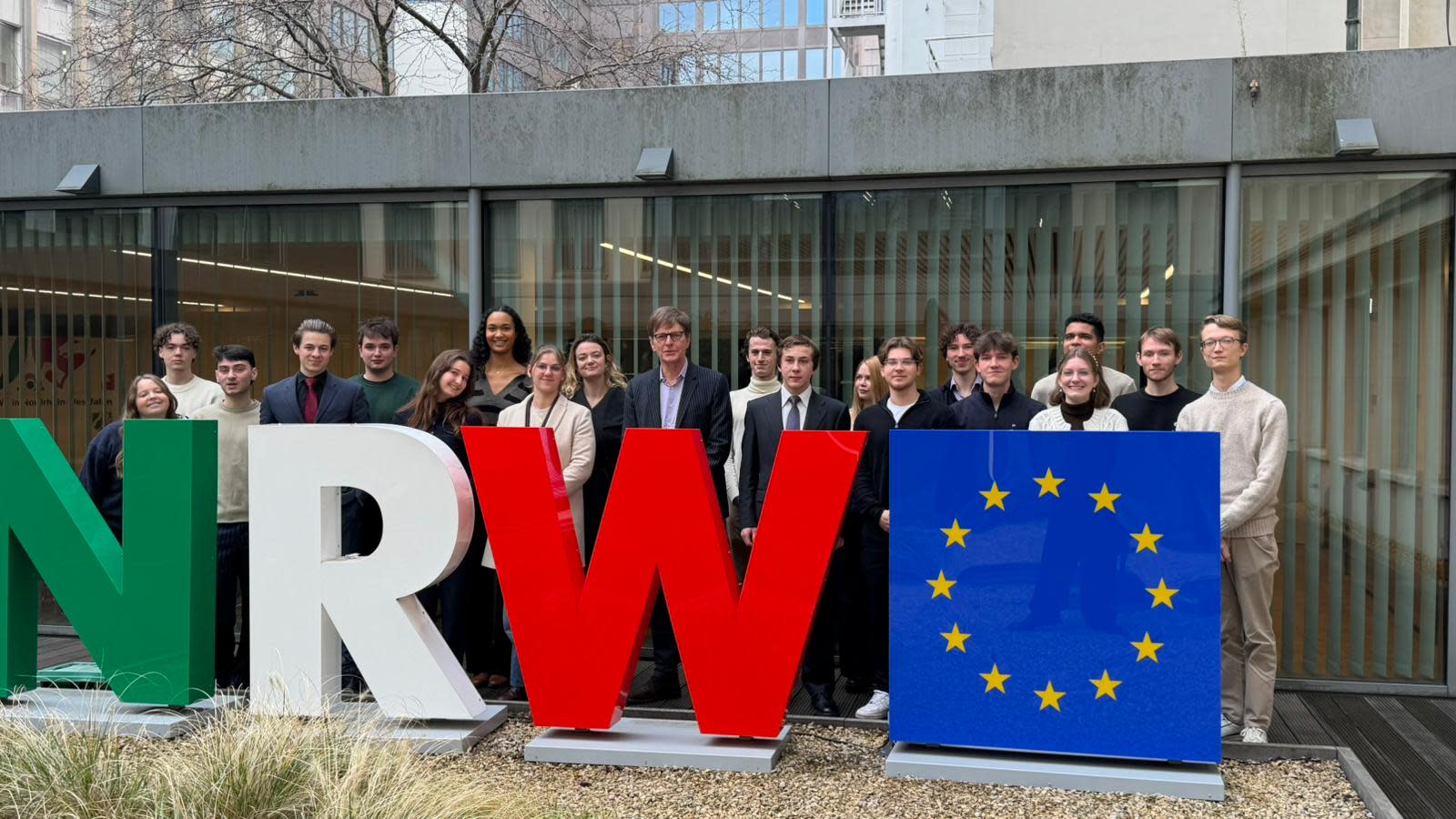
On Wednesday, 26 November 2025, we had the opportunity to visit the Representation of North Rhine-Westphalia to the European Union and to discuss with its representative, Mr. Rainer Steffens.
The Land of North Rhine-Westphalia occupies a very important place in the European Union (EU). With its 18 million inhabitants, it exceeds the population of multiple EU member states and is broadly equivalent to the Netherlands in demographic terms. If it were a Member State, it would be the 7th largest and the 6th most important in terms of economy. The region's ties with the European Union are all the stronger given that 22 members of the European Parliament (MEPs) come from there. However, as Mr. Steffens pointed out, North Rhine-Westphalia is not a Member State but only a region. As a result, it does not have direct access to European institutions such as the Commission or the Council, and has only very limited access to the European Parliament through its MEPs.
NRW's interests are therefore represented within the EU by the Committee of the Regions, an advisory body created by the Maastricht Treaty in 1992. This Committee offers a form of institutional legitimacy for the Land's concerns and requests to the Commission and the European Parliament, by allowing it a form of access.
The Länder are quite unique regions in Europe. They have significant powers, with their own parliaments, governments and competences. Like the Italian, Spanish and Belgian regions, the German Länder play an important role in Brussels. By comparison, the French regions and Dutch provinces, although still important, play a lesser role. The Nordic regions (Denmark, Sweden and Finland), for their part, tend to be less active.
Mr. Rainer Steffens then gave us a brief overview of the history and functioning of the representation. The North Rhine-Westphalia office was one of the first German Länder offices to be established in Brussels in the 1980s, with the aim of representing its concerns and interests to the EU. However, this diplomatic initiative did not go smoothly at first, due to conflicts with the federal government. Indeed, foreign policy is a competence held by Federal Foreign Office (Auswärtiges Amt) and is not held by the Länder. This conflict has been resolved and relations with the federal government are now very positive.
Around 30 people are employed in this office, and around half of them are representatives of the various ministries of the Land (in Düsseldorf). Their daily work consists of developing their network by organising numerous events and inviting important figures (politicians, commissioners, etc.) and stakeholders. Despite this, they sometimes feel excluded from the actual decision-making process. They also organise cultural events with the aim of promoting the culture of their region, such as Carnival, which brought together more than 800 people in costume last year. The links with the state government in Düsseldorf are very tight, enabling the office to receive instructions on the positions it should adopt.
After these general presentations, we were able to discuss North Rhine-Westphalia’s various interests and strategic priorities with Mr. Steffens. Industry and business are very important to the Land. Indeed, nearly half of Germany's 50 highest-earning companies are located in the territory, including 14 major corporations. It therefore has to take into account a diversity of interests, with Mr. Steffens emphasising that it is difficult to be sure that they all speak with one voice. The Land has a particular interest in the coal and mining industry, which leads to inter-regional cooperation, resulting, among other things, in regular meetings between experts from different representations and offices. These partnerships are not limited to the German Länder, as North Rhine-Westphalia also maintains relations with neighbouring regions such as Flanders, and more distant regions such as Hauts-de-France, Silesia (Poland) and Piedmont (Italy).
North Rhine-Westphalia also has an interest in the military and defence sectors, although these are normally the responsibility of the federal government. Indeed, Russia's full-scale invasion of Ukraine in 2022 has changed the context, and the Land must now consider how it can contribute to and organise its defence. In addition, the military mobility package proposed by the Commission is of particular relevance to this Land, as it is a transit area between Western and Eastern Europe for the transport of troops and military equipment. However, North Rhine-Westphalia faces transport infrastructure problems that require investment.
Finally, we had the opportunity to discuss issues that have significantly affected the Land, and Germany more broadly in recent years. For example, the 2015 Volkswagen scandal had a major impact on the Land, even though the company is not based there. This is because many jobs in the region depend on the automotive industry. This scandal led them to create a group on regional automotive production within the Committee of the Regions in order to discuss the various problems and ways of modernising this industry.
The Land is also facing a rise in support for far-right populist parties (AfD), and migration-related issues which are difficult to address at the European level. Finally, North Rhine-Westphalia is also an agricultural region and faces environmental problems, which it is committed to tackling, although conservatives have been seeking to weaken environmental policies for many years.
We warmly thank Mr. Rainer Steffens and the staff of the North Rhine-Westphalia office for welcoming us and for generously sharing their time and insights with us. This visit was a great opportunity for us to learn about regional diplomacy issues and challenges within the European Union.